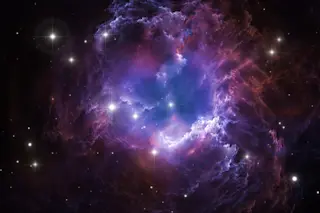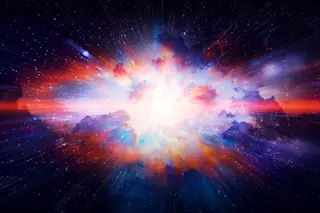



A supernova that was observed in 1680 by Britain's first Astronomer Royal, John Flamsteed, has been revealed to have produced a strange little neutron star that will give astronomers insight into how such stars are born and mature.
The remains of the supernova, known as Cassiopeia A, have been something of a mystery to astronomers. Supernovae usually leave behind an extremely dense object such as a black hole or neutron star. But for decades no such object was seen at the centre of Cassiopeia A [Nature News].
Now new observations suggest that the 330-year-old neutron star escaped detection because of its odd atmosphere.
Instead of resembling more mature neutron stars, which are surrounded by hydrogen, this baby star is blanketed in carbon gas – a discovery that could provide important new insights into the evolution of neutron stars [Physics World].
The new study, published in Nature, suggests that the star is still extremely hot in the aftermath of the supernova--about 2 billion degrees Fahrenheit. This overheated condition caused a nuclear fusion reaction on the star's surface that converts all the hydrogen and helium into carbon gas, researchers say. As time goes on, and as the star cools, the researchers think the surface fusion reaction will stop and the star will develop a more traditional hydrogen atmosphere. Related Content: 80beats: Detoured Light From Tycho’s Supernova Finally Makes it to Earth 80beats: Mysterious Stellar Blast in the 1840s Was a “Supernova Imposter” DISCOVER: Sliced: Inside a Supernova DISCOVER: One Spectacular Stellar DeathImage: NASA / CXC / Southampton / W. Ho / M. Weiss