

"In many species, older males are often preferred mates because they carry "good" genes that account for their viability. In some animals, including mice, which rely heavily on chemical communication, there is some indication that an animal's age can be determined by its scent. In order to identify the attractants in aged male mouse urine, chemical and behavioral studies were performed. We herein show that aged mice have higher levels of 3,4-dehydro-exo- brevicomin (DB), 2-sec-butyl-4,5-dihydrothiazole (BT), and 2-isopropyl-4,5-dihydrothiazole (IT) and a lower level of 6-hydroxy-6-methyl-3-heptanone relative to adult male mice. We also demonstrate that the attraction of females to the odor of male mouse urine is greater when the urine is from aged males. However, the attraction of aged urine odor was offset by the ultrafiltration of adult and aged mouse urine. When DB, BT, and IT were added to adult urine, the attraction of the urine was enhanced. Our results suggest that inbred aged male mice develop an aging odor that is attractive to female mice in an experimental setting and that this attraction is due to increased mouse pheromone signaling."
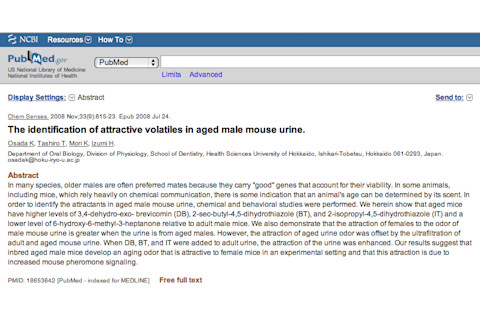
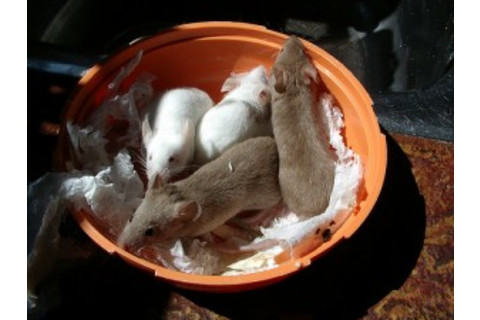
Photo: flickr/Ruud Hein
Related content: Discoblog: NCBI ROFL: One rat, one cup.
Discoblog: NCBI ROFL: You know what they say about barnacles with long legs…
NCBI ROFL. Real articles. Funny subjects. Read our FAQ
!