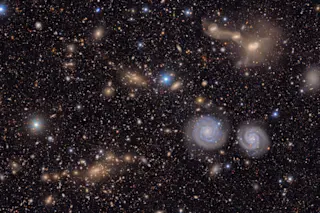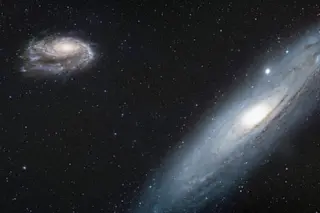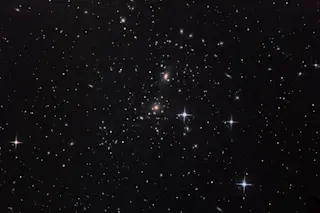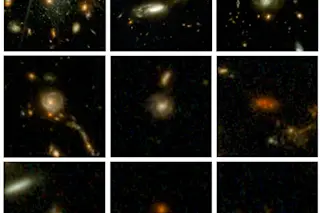


I've posted before about Galaxy Zoo, and see also Phil Plait's posts introducting the zoo, oncounterintuitive results and what do to if you find something weird. They had a pretty cool collective result recently, discovering tiny galaxies that are rapidly forming stars, that they call "green pea galaxies" (which is apparently a different sort of beast from the non-galaxy I called a green crayon in my initial post) -- see here for more or here for the paper itself. Anyways, Galaxy Zoo has just announced a new project, the supernova zoo.
This time, not only are we classifying galaxies, but we're hunting supernovae : exploding stars. Images of likely supernova candidates captured by a telescope in California are being fed to our website at http://supernovae.galaxyzoo.org". Astronomers are standing by in the Canary Islands to follow up on the most exciting possibilities, but first we need your help to decide where to point the telescope. Please take the time to go to the site, read the tutorial – and then start hunting.
I have to say I love the image of "astronomers standing by". I tried it (classifying supernovae, not standing by) -- it's pretty cool, and actually a bit challenging. What you actually do is answer a series of questions about a supernova candidate, to determine whether it's a good candidate or just a messed up image. Here's an obvious good one:
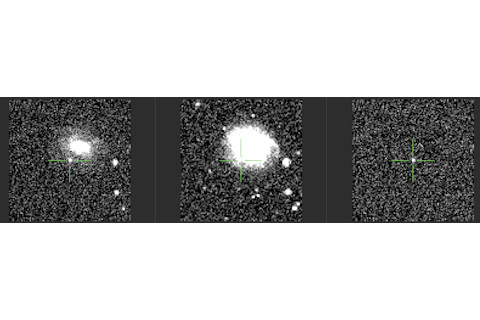
And one where the candidate (right image) is distorted so it doesn't look like a star.
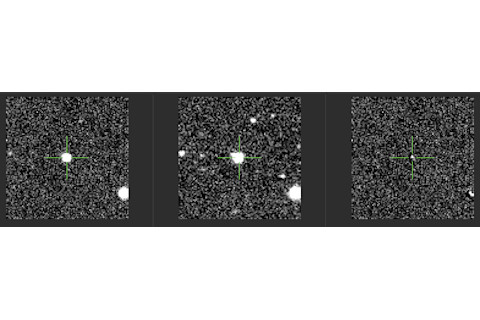
To my mind it's not nearly as interesting as the galaxy zoo, because images of galaxies are just way cooler than low-resolution images of supernovae (supernovae remants are another story of course). But it's a great use of human eyes, and a pretty good way to waste a few lazy August afternoons. It will definitely be interesting to see if the data is useful enough to help the supernovae followup substantially. Have at it! Maybe they'll name the next supernovae "SN2009cosmicvariancereaders".