

2001 Awards IndexEditors' choiceElectronicsTransportationHealthEntertainmentAerospaceCommunications Environment FinalistsThe Christopher Columbus Foundation Award

ENVIRONMENT
PATRICK GRUBER
CARGILL DOW
MINNETONKA, MINNESOTA
NATUREWORKS PLA:PLASTIC MADE FROM CORN
Photograph by Jeff Sciortino
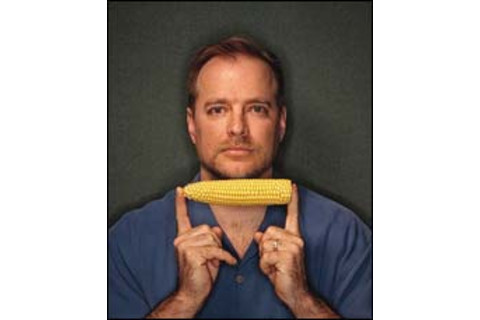
In 1989 Pat Gruber was just a fledgling chemist, 29, fresh out of graduate school, when his bosses at the agricultural giant Cargill pitched a problem that stumped him: Come up with new uses for corn. For six months his group brainstormed, imagining new syrups, acids, fuels. But nothing held greater promise than biodegradable plastic. One day, walking from desk to workbench, Gruber stopped dead: "It just hit me," he recalls. "A lightbulb went off in my head and I thought, 'Hey, I know how to do it.' And the process hasn't changed in 10 years."
Now 40 and a vice president of the new conglomerate Cargill Dow, Gruber presides over the development of a product that requires 20 percent to 50 percent less of fossil resources to make than petroleum-based plastics and turns into harmless dirt in composting facilities. The key ingredient is polylactide, or PLA. To produce it, ordinary corn syrup is fermented to generate lactic acid, the sour liquid one smells in spoiled milk. The acid is heated to wick away water, which forces the acid molecules to bind together in ring-shaped structures called lactide monomers. A catalyst is added that severs these bonds and triggers a chain reaction. As each ring pops open, it craves stability and latches onto another monomer, forcing it to pop open. And so the elegant process continues, until tens of thousands of monomers form a single polymer strand. The strands stack up on top of, or become entangled with, adjacent strands. The result is a tiny clear pellet that can be melted and extruded into just about any shape.
Cargill Dow's Blair, Nebraska, plant, operational later this year, will produce 300 million pounds of pellets a year. Thinking back on all the years he put into making his vision a reality, what amuses Gruber is that, when he first got his brainstorm, he was so new an employee that he didn't even have enough lab equipment. With his wife, also a chemist, he brewed the first batch of the polymer at home on the kitchen stove, a story they still love to tell their children.