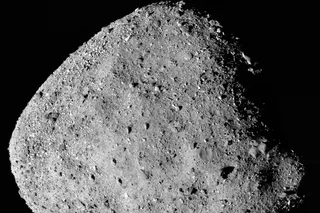


William Bottke of the Southwest Research Institute in Boulder, Colorado, has shown that solar rays can change an asteroid’s rotation or even nudge it out of its orbit. His discovery explains an old puzzle. Some groups of asteroids spin at nearly the same rate and in similar directions. Bottke says this strange synchronization could be caused by sunlight. Solar rays warm up an asteroid’s surface, just as asphalt cooks on a hot summer day. As the heat is reradiated into space, the escaping energy produces a slight twisting force.
Over billions of years, this minuscule effect can significantly speed up or slow down an asteroid’s spin, depending on its initial orientation. In some cases, sunlight can cause an asteroid to rotate so quickly that it flies apart, shedding rubble that then orbits like a cloud of tiny moons. Light pressure also influences an asteroid’s path through space. “Sunlight can slowly ...