
skip to main content

Wednesday Whatzits: Yellowstone earthquakes, Hawaiian lava and the hazards at Gran Canaria

Discover the latest insights on the Gran Canaria volcano's hazard map and its history of eruptions over the past 11,000 years.

Written byErik Klemetti
| 2 min read
Follow on GoogleGoogle News Preferred Source
Placeholder image

Newsletter

Sign up for our email newsletter for the latest science news

Sign Up

Quick news updates for a Wednesday...

Placeholder image showing Earth from space with an alert icon and the message ‘This image is no longer available.’

The island (and volcano) of Gran Canaria in the Atlantic Ocean. It last erupted in ~20 B.C.

  • The earthquakes keep coming at Yellowstone - up to a M3.5 in the last 24 hours. Time has already put up an article wondering about whether people need worry about the swarm (there might be other things to worry about before this swarm). YVO's statement on the earthquake swarm seems pretty standard (as it should be): "At this time the Yellowstone Volcano Observatory does not consider the swarm to be unusual and the earthquakes are likely related to tectonic fault sources. Also there is no indication of premonitory volcanic or hydrothermal activity, but ongoing analyses will evaluate these different sources."Eruptions reader Akira Shirakawa has posted another audio transcription of the seismicity on the January 19th, including the M3.5 quake for your listening (and pondering) pleasure.

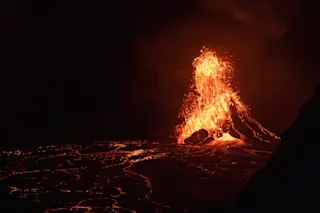
  • Not really much science in this article, but some cool pictures of HVO scientists going right up to the front of an a`a flow. A'a flows tend to move slow in a tractor-tread fashion, so description of the scientists as choosing to "stare death in the face to get a closer look" is a little over the top, but hey, it is the The Mail. The Halema`uma`u Crater activity continues unabated and an aerial video of the crater shows the stream of lava coming from the vent at the bottom.

  • Finally, if you're interested in the Canary Islands, a hazard map/assessment has been published for Gran Canaria in the Journal of Quaternary Science. Twenty-four eruptions have occurred in the last 11,000 years on the island, meaning that there is an eruption every ... just kidding! The eruptions are dominantly small monogenetic strombolian cones and, occasionally, phreatomagmatic calderas. It is the north side of the island that faces the most risk in future eruptions, according to the study.

Meet the Author

Related Topics

Stay Curious

JoinOur List

Sign up for our weekly science updates

View our Privacy Policy

SubscribeTo The Magazine

Save up to 40% off the cover price when you subscribe to Discover magazine.

Subscribe