

Most people don't realize that a majority of the earth's volcanoes are underwater. That is to say, the mid-ocean ridge system that runs along the bottom of all the major oceans can be considered one big volcano. However, thanks to its location deep underwater, we have only had second- or third-hand evidence of eruptions at mid-ocean ridges or seamounts.
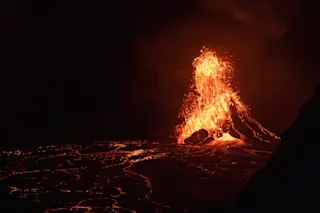
Not any longer according to my graduate alma mater, Oregon State University. An active eruption was captured at Brimstone Pit in 2006, near Guam, by a team looking for hydrothermal activity at the sea's bottom. The eruption appears to be a very gassy eruption - explosive undersea activity! The research team were able to record the sounds of the eruption from Brimstone Pit (also known by the less sexy name NW Rota-1) and see some of the glowing from the extruded lava (although apparently there wasn't much lava that they could ...