
Advertisement

The Dusty Path Toward Doom

Discover the stunning features of spiral galaxies like NGC 1097, home to a supermassive black hole and intricate dust formations.

Google NewsGoogle News Preferred Source

Newsletter

Sign up for our email newsletter for the latest science news

Sign Up

Yesterday, I talked briefly about what infrared images can tell us about dust in spiral galaxies. In a funny coincidence, the European Southern Observatory put out a press release todayabout a new image that discusses a similar topic! In this case, though, the arms lead down to a bottomless pit: a black hole in the center of a spiral galaxy called NGC 1097. Galaxies are vast collections of stars, gas, and dust. At first glance, NGC 1097 looks like a fairly typical spiral galaxy:

Advertisement

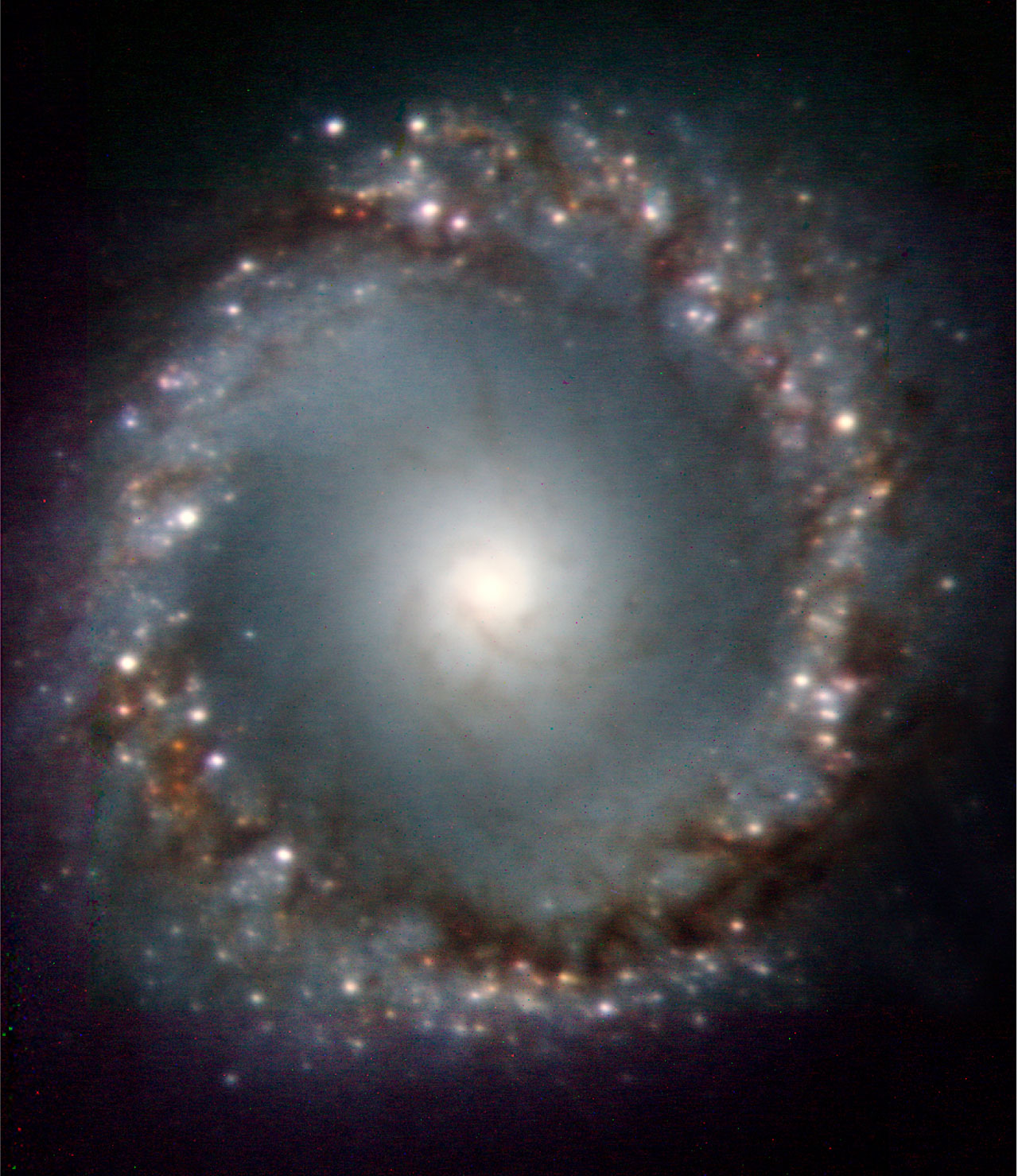
Pretty, isn't it? Our Milky Way would look a lot like that from a few million light years away, too. Sometimes, this kind of galaxy is called a "grand design" spiral, because the spiral pattern is so big and obvious. But what's interesting is what happens when you zoom in on the nucleus:

The blobby ring there is a circle of dense clouds of gas and dust forming stars. But if you look carefully, you can see that the dust inside the ring is forming a spiral pattern, and it looks like it's swirling down into the nucleus! This image has incredible resolution, rivaling Hubble's for seeing small objects. The astronomers then processed the image a bit to bring out faint details, and made this way cool image:

The dark ellipse is the region in the image where they enhanced it. With the brighter glow suppressed, you can actually clearly see the dust arms dropping right down into the center of the galaxy! And what happens there? Well, it's too small to be seen in these images, but inside that galaxy, right at its very heart, is a supermassive black hole. It's called "supermassive" because it tips the cosmic scales at about a million times the mass of the Sun

. Even then, it's kindof small for a galaxy's central black hole. The one in the center of the Milky Way is four times that mass. Anyway, that dust from the outer part of the galaxy core is falling into that black hole. As it falls in, it forms a disk called an "accretion disk", which gets very hot. The disk is like a holding pattern for the gas, a place to pile up before it falls into eternity. Since the disk gets hot, it emits light. In some galaxies it gets very bright, outshining the galaxy itself -- in those cases, the galaxy is said to be "active"). So ironically, even though black holes are known for gobbling down even light, they can power some of the brightest objects in the Universe! Like I said in yesterday's blog entry

: studying the dust in a galaxy can tell us a lot about it, even about things we can't see.

Stay Curious

JoinOur List

Sign up for our weekly science updates

View our Privacy Policy

SubscribeTo The Magazine

Save up to 40% off the cover price when you subscribe to Discover magazine.

Subscribe
Advertisement

1 Free Article