
Spotted: Signature of Water in Microwave Laser Produced by Distant Galaxy

Researchers uncover water masers in distant galaxies, revealing new insights into supermassive black holes and early universe conditions.

| 2 min read
Google NewsGoogle News Preferred Source

Newsletter

Sign up for our email newsletter for the latest science news

Sign Up

In a galaxy far, far away—11.1 billion light-years away, to be exact—researchers have discovered the telltale signature of water.

The water molecules seem to be located in the galaxy's center, where a supermassive black hole called a quasar is spewing out tons of radiation as material falls into it. The water molecules lie in clouds of dust and gas that feed the black hole, and appear to be amplifying radio waves at a specific frequency, forming what's called a maser, or the radio equivalent of a laser [Wired News].

The quasar, called MG J0414+0534, is so far away that the light researchers are observing originated when the universe was only 2.5 billion years old.

"We now know water is out there," says Violette Impellizzeri from the Max Planck Institute (MPI) for Radio Astronomy in Bonn, Germany. "Because water masers arise close to the cores of galaxies, our result opens new interesting possibilities for studying supermassive black holes [at the galactic cores] at a time when galaxies were forming" [New Scientist].

The study, published in Nature [subscription required], may force researchers to revise their understanding of water masers. Because such masers have been detected in only five percent of nearby energetic galaxies researchers assumed they were rare throughout the universe; the probability of finding such a bright maser in an active galaxy was thought to be one in a million. But the

fact that Impellizzeri's team discovered one in the first distant galaxy they looked at suggests these masers must have been far more common in the early universe than they are now. "The fact that it's the first one is fantastic," [said] MPI team member John McKean.... "It will really motivate others to look for objects like this" [New Scientist].

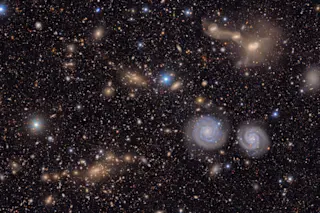
Researchers were able to observe the distant galaxy through a trick called gravitational lensing, which was predicted in Albert Einstein's general theory of relativity. This effect refers to the way that light from a distant source is bent around a closer galaxy and is magnified; because the quasar's galaxy was so far away, researchers would never have been able to study it without this magnifying boost. Researchers are delighted with the work done to detect water in the ancient quasar galaxy, and say future high-powered telescopes, like the Square Kilometre Array, may be able to focus in on these water masers to learn more about how young galaxies behaved in the first few billion years after the Big Bang. Related Content: DISCOVER: In the Beginning, All Was--Black Holes? DISCOVER: The Quasars New Clothes reveals how little we know about quasars DISCOVER: Quasars in the Neighborhood?Image: CFHT, J.-C. Cuillandre, Coelum

Meet the Author

Related Topics

Stay Curious

JoinOur List

Sign up for our weekly science updates

View our Privacy Policy

SubscribeTo The Magazine

Save up to 40% off the cover price when you subscribe to Discover magazine.

Subscribe