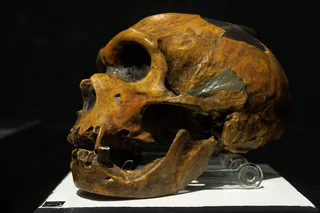

Neanderthals Also Had Superior Toolmaking Abilities, Not Just Humans

Research at multiple archaeological sites has now confirmed that Neanderthals made tools once seen as a sign of superior human intelligence.

Written byMatt Hrodey
| 2 min read
Google NewsGoogle News Preferred Source
Prehistoric Early Man Neanderthal. 3D renderingCredit: RaveeCG/Shutterstock

Newsletter

Sign up for our email newsletter for the latest science news

Sign Up

We like to think of ourselves as special. We’re Homo sapiens, after all. But a new study of Ice Age Europe has found that our supposedly unique bone tools, a sign of higher intelligence, weren’t so unique after all. Neanderthals fashioned and used hundreds of the same tools while butchering animals and preparing hides, according to a new paper.

Evidence for this has arisen, in recent years, from two Neanderthal sites of some note – starting with the Chagyrskaya Cave in the Altai Mountains in Siberia. Here, researchers found about 1,200 bone tools, including a large number of “retouchers,” which act as light hammers for cutting and shaping stone tools.

The scientists envisioned that, some 60,000 years to 50,000 years ago, Neanderthals hauled dead bison to the cave through cold weather for processing. Like early H. sapiens, they used animals as sources for both food and raw materials. And it sure looked like they manufactured bone tools. But was Chagyrskaya an isolated pocket of innovation or part of something wider?

Neanderthals in France

Besides Chagyrskaya, simple bone tools have turned up in small numbers at Neanderthal sites in Crimea, Ukraine, Germany and the Czech Republic.

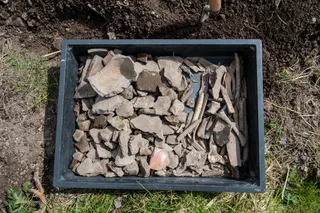
But until 2019, researchers had waited for another major processing site like the Siberian cave. They found one in France, at the existing Chez-Pinaud site, positioned near a tributary of the Charente River. In 2019 and 2020, archaeologists from France, Belgium and Russia excavated a small area and found 103 bone tools, including 83 retouchers.

They concluded that hunter-gatherer Neanderthals had used the site to process a wide range of animals, including reindeer, horses and bison, during the cold season.


Read More: Ancient Predators: A Guide to the Neanderthal Hunt


New Evidence of Neanderthal Toolmaking

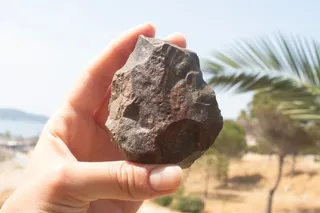
As they cleaned off bones harvested from the large-hoofed animals, Neanderthals made retouchers, beveled tools and at least one rounded tool similar to a present-day leather-working instrument. The Neanderthals likely used the retouchers to sharpen stone tools dulled from scraping carcasses. And the rounded tool would have come in handy while processing hides.

Researchers looked for fresh bone cuts carried out shortly after the animal had died, and not accidental damage. Those indicated the work of a living, thinking Neanderthal who may have cut the bone down to size or shaped an edge. Overall, these craftsmen made small tools, with the largest measuring about 6 inches in length.

“Bone tools represent a new means for exploring and understanding Neanderthal technology,” said a statement, “which has apparently not yet revealed all its secrets.”

A multi-functional bone tool from the France site. (Credit: M.Baumann-TraceoLab-ULiège)

M.Baumann-TraceoLab-ULiège


Read More: What Types of Tools Did Neanderthals Use and Develop?


When Modern-Day Humans Took Over

Some 45,000 years ago, H. sapiens migrated into Western Europe and replaced the Neanderthal population, which eventually went extinct.

To fill the void, Ice Age humans developed surprisingly sophisticated cultures with bone jewelry, group hunting techniques and houses made out of mammoth bones. To our credit, we left behind a deep record of bone instruments, including large tools and weapons and smaller figurines and ornaments.


Read More: Why Did Neanderthals Disappear?


Meet the Author

  • MH
    Matt is a staff writer for DiscoverMagazine.com, where he follows new advances in the study of human consciousness and important questions in space science - including whether our universe exists inside a black hole. Matt's prior work has appeared in PCGamesN, EscapistMagazine.com, and Milwaukee Magazine, where he was an editor six years.View Full Profile

Related Topics

Stay Curious

JoinOur List

Sign up for our weekly science updates

View our Privacy Policy

SubscribeTo The Magazine

Save up to 40% off the cover price when you subscribe to Discover magazine.

Subscribe