
Advertisement

How Primordial Galaxies Grew Like Gangbusters

Massive galaxies formed quickly after the Big Bang, drawing in streams of cold gas for star formation, not through violent mergers.

Google NewsGoogle News Preferred Source

Newsletter

Sign up for our email newsletter for the latest science news

Sign Up

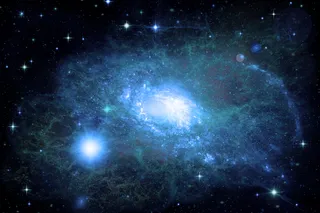
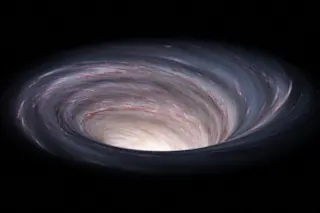
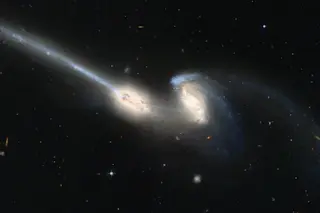
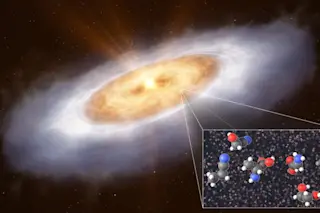
When the universe was young, massive galaxies formed quickly but surprisingly peacefully. Researchers say they've found evidence that these galaxies didn't grow by sucking up the remnant materials from supernovae or by violent collisions with other galaxies--instead they were fed by streams of cold gas that were funneled into their central star-forming region.

Advertisement

Astronomers using the European Southern Observatory's Very Large Telescope in Chile have observed three primeval galaxies with patches of star formation near their centers, away from the heavy elements that signal the remains of previous stars. The team found that these galaxies were sucking in cool hydrogen and helium from the space between galaxies as fuel. "It solves the problem of providing to the galaxies fuel to form their stars in a continuous way, without having to invoke violent mergers and galaxy interactions," said study researcher Giovanni Cresci. [SPACE.com]

The study

, published in Nature, describes three galaxies that formed just 2 billion years after the Big Bang--which created lots of hydrogen and helium to feed hungry, growing galaxies, but created few heavier elements. Those formed later in stars and supernovae. Related Content: 80beats: Hubble Spies Baby Galaxies That Formed Just After the Big Bang

Bad Astronomy: Hubble Sees Ancient Galaxies Rejuvenating Themselves

Bad Astronomy: Hubble Digs Deep to See Baby Galaxies

DISCOVER: Scientists Are Ready to Build Some Galaxies

DISCOVER: Are Black Holes the Architects of the Universe?

Image: L. Calcada (ESO)

Stay Curious

JoinOur List

Sign up for our weekly science updates

View our Privacy Policy

SubscribeTo The Magazine

Save up to 40% off the cover price when you subscribe to Discover magazine.

Subscribe
Advertisement

1 Free Article