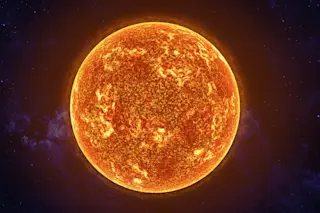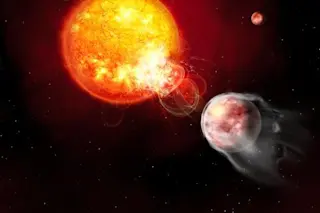

In a star system 330 light years away from Earth, astronomers have spotted a giant planet that booms around its parent star in tight, fast circles, completing an orbit (the planet's "year") in less than one Earth day. The exoplanet, known as Wasp-18b, is so close to its star that researchers say it appears to be spiraling inwards to its fiery doom. But the odds of seeing a planet in its death throes are so low that researchers are searching for alternate explanations, and say the planet
could force scientists to rethink established ideas about planetary forces known as tidal interactions [National Geographic News].
The planet is known as a "hot Jupiter," meaning that it's a massive gas giant like our own solar system's Jupiter, but it orbits in close proximity to its star.
Current theories say that such a massive planet so close to its star should be pulling on the host star, creating a tidal effect similar to the moon's pull on Earth. At that range the planet's pull would be so strong that it would drain energy from its orbit, causing the planet to rapidly fall into the star [National Geographic News].
But if that's the case, the planet would meet its death in less than a million years. Since the star system is thought to be about 1 billion years old, the odds of catching the planet in its last stages are one in a thousand. In the study, published in Nature, researchers list other explanations for the odd state of affairs.
One possibility is that Wasp-18, a sunlike, medium-sized star, is a thousand times less energetic than would be expected. That would mean it produces much less friction on the planet than normal. This orbital drag, which scientists call the "tidal dissipation factor," slows a planet each time it circles its star [Los Angeles Times].
If the star is producing less friction, it may not be slowing the planet's orbit as much as expected. However, this would suggest that sun-like stars can have characteristics that scientists have never seen before. Astronomer Douglas Hamilton, who wasn't involved in the research, says the
final possibility is that "we're just missing something -- there is some property of stars or tides that we just don't understand."... An answer could be coming in just a few years. According to [lead researcher Coel] Hellier, if the orbit of Wasp-18b really is decaying at the expected rate, the effects should be measurable within the next decade [Los Angeles Times].
Related Content: 80beats: For the First Time, Astronomers Observe the Phases of a Red-Hot Exoplanet 80beats: New Telescope Could Reveal a Milky Way Packed With Habitable Planets 80beats: Small, Rocky Exoplanet Is the Most Earth-Like World Ever Seen 80beats: First Ever Weather Report From an Exoplanet: Highs of 2240 Degrees DISCOVER: How Long Until We Find a Second Earth?Image: C. Carreau / ESA