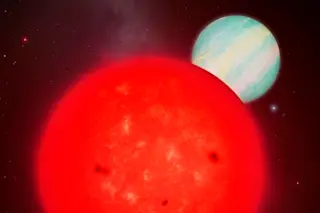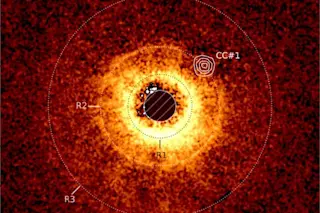

It may be getting old hat for some astronomy researchers, but the discovery of new exoplanets—planets orbiting stars far from our little solar system—can still send a shiver of excitement through space buffs. And today was a jackpot, as European researchers announced that they'd found a trio of "super-Earths" that are only slightly larger than our own planet, and that the three are all orbiting the same star 42 light years away.
They said their findings, presented at a conference in France, suggest that Earth-like planets may be very common. "Does every single star harbour planets and, if yes, how many?" asked Michel Mayor of Switzerland's Geneva Observatory. "We may not yet know the answer, but we are making huge progress towards it," Mayor said in a statement [New Scientist].
Researchers have found almost 300 exoplanets since 1995 by using the same technique.
When a planet orbits its star, it exerts a gravitational pull which causes the parent star to "wobble" around its centre of mass. The High Accuracy Radial velocity Planet Searcher (HARPS) spectrograph was able to measure this wobble to a very high precision over a period of five years [BBC News].
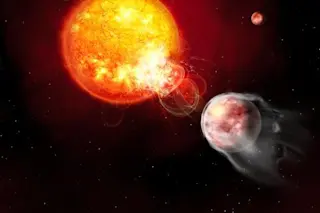
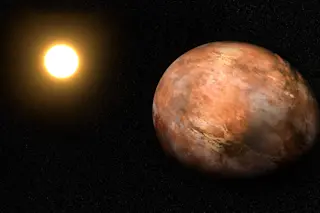
The HARPS telescope has been dubbed the "planet hunter" because it has revealed 45 super-Earths since it began operation in 2004. Most of the planets identified thus far have been gas giants like our own Jupiter and Saturn; smaller, rocky, Earthlike planets are harder to spot because they're less massive. The three newly discovered planets are bigger than Earth, but not by much: They're 4.2–9.4 times as heavy. But despite earning the promising title of super-Earths, the planets aren't likely to harbor any form of extraterrestrial life. They hug their sun in a close orbit and take only a few days or weeks to make one rotation, which means they're likely to be super-hot infernos. This discovery comes just a few weeks after American researchers announced the discovery of a small planet orbiting a dim star, which is thought to be too frozen (and radiation-blasted) to support life. But researchers will keep looking for a Goldilocks planet that is neither too hot nor too cold.
"In a year or two, it is likely that we will find habitable planets circling small stars" such as the Sun, said Setphane Udry, a researcher at Switzerland's Geneva Observatory and a member of the team that made the discovery [AFP].
Image: The European Southern Observatory (ESO) Related Post: New Planet Points the Way for ET Hunters