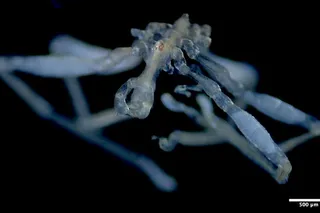
Cassiopea jellyfish spend much of their adult lives lying on their backs. Or maybe their heads. However you look at it, they're upside-down: they rest in warm, shallow waters, holding their branching arms up toward the sun. Inside those tentacles are single-celled algae, which photosynthesize and provide food for their jelly farmers.
Cassiopeia, the jellyfish's differently spelled namesake, was a queen in Greek mythology. After bragging that she was even more beautiful than sea nymphs called the Nereiads, the queen was punished by having her constellation placed where it sometimes appears upside-down as it rotates in the sky.
The jellyfish are passive but have a mild sting. Some crabs hoist Cassiopea jellyfish onto their backs for self-protection, carrying them around gardens and all.
Image: Cassiopea jellyfish at Shedd Aquarium, taken by me. If you like seeing bizarre animals up close (or adults with their faces pressed up to glass like kids), go see this exhibit.