
Advertisement

Finally, a World Map That Doesn't Lie – The AuthaGraph Is the Most Accurate Map of Earth

We're long overdue for an accurate world map. Get the real story behind different map projections and see which one is the most accurate map of the world.

ByNathaniel ScharpingandErin Berge
|Last Updated
Google NewsGoogle News Preferred Source
The Authagraph projection, most accurate world map
The Authagraph projection, most accurate world map(Image Credit: Jason_Li/Shutterstock)

Newsletter

Sign up for our email newsletter for the latest science news

Sign Up

Key Takeaways on the Most Accurate World Map

  • The AuthaGraph is the most accurate world map. The 2016 winner of Japan’s prestigious Good Design, Hajime Narukawa, a Tokyo-based architect and artist, broke the globe up into 96 regions and folded it into a tetrahedron and then a pyramid before finally flattening it into a two-dimensional sheet.
  • For centuries, cartographers have made numerous attempts to account for the inconsistency while trying to recreate the most accurate map of the Earth. Maps are compromises between distorting the angles of latitude and longitude lines and the relative areas of the continents and oceans.
  • Narukawa says that his map is not quite accurate yet — some regions are slightly distorted. He hopes to perform even more subdivisions of his globe to achieve true representations of the continents and ensure the most accurate map of the world.

Our maps have been lying to us for centuries.

Advertisement

The standard classroom maps we all learned geography from are based on the Mercator projection, a 16th century rendering that preserved lines used for navigation while hideously distorting the true sizes of continents and oceans further from the equator. The result is a widespread misconception that Greenland is as big as Africa, Siberia and Canada are disproportionately massive, and that Antarctica apparently just goes on forever.

In reality though, Africa is larger than all of North America, and the Antarctic is about as big as Australia. That’s the difficulty with stretching a sphere to fit a rectangle, and for centuries cartographers have struggled to balance maintaining straight latitudinal lines with the preservation of perspective. But the AuthaGraph may be the pinnacle of accuracy.

Mercator Projection (Credit: Daniel R. Strebe/Wikimedia Commons)

Daniel R. Strebe/Wikimedia Commons


Read more: 6 of the World’s Oldest Maps


Why Is an Accurate World Map Hard to Come By?

For centuries, cartographers have made numerous attempts to account for the inconsistency while trying to recreate the most accurate map of the Earth. Maps are compromises between distorting the angles of latitude and longitude lines and the relative areas of the continents and oceans.

Some were made for specific purposes, while others just tried to find the cartographic sweet spot. The problem was so widespread that a French mathematician even developed an eponymous equation to quantify the degree of distortion that a world map experienced. Called Tissot’s indicatrix, the equation takes the form of circles placed at regular intervals across a map. By calculating how much each circle deforms, it is possible to determine how much the map is pulling and stretching the continents out of shape at that point.

Here are a few of the different ways cartographers have tried to depict the Earth.

Sinusoidal Projection

This map bowed out the equator in an attempt to replicate the topography of a sphere and avoid stretching out areas far from the equator. It succeeds in presenting a more accurate view of the poles, but at the cost of misshapen continents and bent meridians. Areas near both the equator and prime meridian are accurate, but the distortion gets worse the further you go from either.

Sinusoidal Projection (Credit: Daniel R. Strebe/Wikimedia Commons)

Daniel R. Strebe/Wikimedia Commons

Robinson Projection

This attempt at creating a faithful world map took a similar tack to the Sinusoidal by pulling out the edges of the map to mimic a sphere. The Robinson isn’t as extreme, however, taking the form of a much more gentle oval. The map was an attempt at a compromise between distorting the areas of continents and the angles of coordinate line. It was used by both Rand McNally and the National Geographic Society at one point.

Robinson Projection (Credit: Daniel R. Strebe/Wikimedia Commons)

Daniel R. Strebe/Wikimedia Commons

Bonne Projection

A more outside-of-the-box example of mapmaking ingenuity, the Bonne Projection actually dates back to the 16th century. The heart shape preserves integrity near the center, but gets progressively more unrealistic as it moves outward. Keeping the focus on Europe and Africa means that most areas of interest to early cartographers were rendered nearly accurately, although Australia does suffer some unfortunate stretching.

Advertisement

Bonne Projection (Credit: Daniel R. Strebe/Wikimedia Commons)

Daniel R. Strebe/Wikimedia Commons

Armadillo Projection

This map attempts a kind of 3-D simulation by projecting the map onto a torus. This keeps the continents in decent shape while causing the oceans to appear smaller, and cutting off half of Australia and all of New Zealand. As with other maps, the tops and sides suffer from the most distortion.

Armadillo Projection (Credit: Daniel R. Strebe/Wikimedia Commons)

Daniel R. Strebe/Wikimedia Commons


Read More: 6 of the World’s Oldest Maps

Advertisement

What Is the Most Accurate Map of the World?

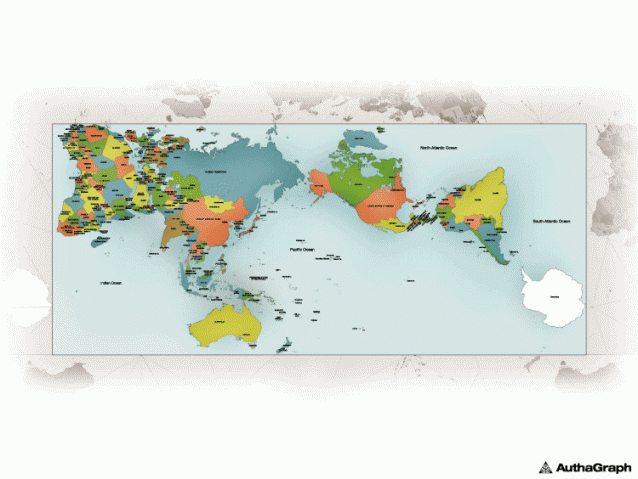
We may finally have a faithful flat map, however. The 2016 winner of Japan’s prestigious Good Design, designers figured out how to translate our spherical world into a rectangular box. Hajime Narukawa, a Tokyo-based architect and artist, broke the globe up into 96 regions and folded it into a tetrahedron and then a pyramid before finally flattening it into a two-dimensional sheet.

The multi-step process preserves the true dimensions of the continents by angling them outward instead of stretching them, maintaining the illusion that they’re all laid out vertically like we’re used to. Their website states that the goal was to create a map better suited to address the problems of the 21st century, including rapidly diminishing sea ice and territorial claims of marine territory, by more accurately depicting what areas near the poles actually look like.

AuthaGraph

Called the AuthaGraph, the result is a world map that looks a little different than most of us are used to. Seen in rectangular form, Antarctica is intact and at the bottom right.

The Authagraph projection, most accurate map of the world

The Authagraph projection, most accurate map of the world

(Image Credit: Jason_Li/Shutterstock)

The Americas and Africa are tilted inward and pushed to the upper corners of the map, while Australia sits perfectly upright at the bottom center. The lines of latitude and longitude veer in odd directions, the result of transformations that broke them from their naturally spherical configuration.

Advertisement

Read More: The Mystery of Extraordinarily Accurate Medieval Maps


Finally, an Accurate Scale World Map

Most importantly, the continents are all rendered as they actually appear. Africa has regained its geographic primacy while North America and Europe are shrunk back to their true sizes. The oceans, too, are finally represented accurately. By breaking long standing rules governing how the continents and lines of latitude and longitude should appear, Narukawa has achieved a geographically accurate depiction of Earth.

This would make awesome bathroom tiles. (Credit: AuthaGraph)

AuthaGraph

His projection can even be tessellated to create a never-ending sequence of continents laid out next to each other. You can buy an origami version of his map composed of tiny segments separated by seams that folds from a globe to a sheet and back again.

The path of the International Space Station, as mapped over a tessellation of Narukawa's world map. (Credit: AuthaGraph)

AuthaGraph

Narukawa says that his map is not quite accurate yet — some regions are slightly distorted. He hopes to perform even more subdivisions of his globe to achieve true representations of the continents and ensure the most accurate map of the world.

Advertisement

There are also other experts that are researching how to better represent our planet. For example, the Equal Earth map projection uses inspiration from the Robinson projection to create an “equal-area pseudocylindrical projection,” according to the study.


Read More: Earth Actually Has Four North Poles

Advertisement

This article was originally published on Nov. 3, 2016 and has since been updated by the Discover staff.

Article Sources

Our writers at Discovermagazine.com use peer-reviewed studies and high-quality sources for our articles, and our editors review for scientific accuracy and editorial standards. Review the sources used below for this article:

  • Erin Berge headshot

    Erin Berge

    Erin Berge is the Senior Digital Editor for Discover Magazine who oversees the digital strategy and publishing of Discover's website. She also edits and writes articles covering various scientific studies. 

Stay Curious

JoinOur List

Sign up for our weekly science updates

View our Privacy Policy

SubscribeTo The Magazine

Save up to 40% off the cover price when you subscribe to Discover magazine.

Subscribe
Advertisement

1 Free Article