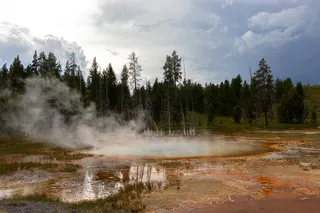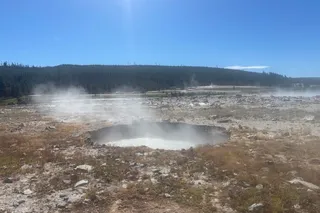


Millions of people visit Yellowstone National Park each year to admire its stunning landscapes and wildlife, but below it all lies a slumbering supervolcano. One question likely comes to mind upon learning about Yellowstone's dormant supervolcano: What if the volcano were to erupt?
In the worst-case scenario, the scene would be devastating. Pyroclastic flows would lay waste to surrounding states of Montana, Idaho, and Wyoming, while plumes of ash would blanket much of the West and spread east across the rest of North America.
This is just a snippet of what could happen if the Yellowstone supervolcano experiences a massive eruption. The chances of this actually becoming a reality are slim to none, but Yellowstone's volcanic past provides insight into what another eruption could look like.
Read More: These Yellowstone Hot Springs Look Peaceful Until They Start Thumping
Yellowstone's Explosive Eruptions
Yellowstone has had a long history of volcanism, with three major explosive eruptions in the past 2.1 million years. The last of the three occurred around 631,000 years ago; this formed a caldera, defined by the Yellowstone Volcano Observatory as a depression usually more than 0.6 miles across, caused by the collapse of a volcano.
Caldera-forming eruptions are the rarest volcanic hazard, representing a magnitude 8 eruption on the Volcanic Explosivity Index (VEI). Volcanoes that have had a VEI 8 eruption (the highest on the scale) are considered “supervolcanoes,” having produced volcanic deposits greater than 240 cubic miles.

 Explore All Options
Yellowstone’s volcanic activity has been much quieter ever since the major eruption 631,000 years ago. Since then, there have been approximately 80 mostly nonexplosive eruptions, most of them rhyolite lava flows that take place from vents within the caldera structures.
Putting Supervolcano Fears to Rest
Yellowstone’s distant volcanic past may sound daunting, but volcanologists are confident that we’re not due for another VEI 8 eruption anytime soon.
According to the U.S. Geological Survey (USGS), the yearly probability of another caldera-forming eruption is around 1 in 730,000, or 0.00014 percent. This is based on the intervals between the three major eruptions, which occurred 2.08, 1.3, and 0.631 million years ago, respectively. This comes out to an average of 725,000 years between eruptions, which would mean that, by this logic, there would technically be another 100,000 years before another eruption could occur, according to the USGS.
However, since this is based on just two time intervals between the eruptions, it’s essentially a meaningless metric to go by, according to the USGS.
Another reason not to panic is that the rhyolite magma chamber beneath Yellowstone is only 5 to 15 percent molten, meaning there may not even be enough magma to feed an eruption.
If an eruption were to ever occur, it likely wouldn’t be caldera-forming, but something more like Yellowstone’s last eruption approximately 70,000 years ago, with slow-moving rhyolite lava flows rather than a violent explosion of ash and debris.
What Would a Yellowstone Eruption Look Like?
Even though an eruption is far from likely at Yellowstone in our lifetime, some volcanologists have conjured up ideas of what would happen if the Yellowstone supervolcano were to awaken.
The first signs of an eruption would be earthquake swarms, a series of small earthquakes. These would be detected weeks before an eruption and may proceed to migrate upward, accompanied by uplift of the ground.
According to a recent article from The Conversation that goes over a hypothetical eruption scenario, shallow earthquakes and rapid uplift, along with more erratic hydrothermal activity, could indicate magma moving upward.
The eventual eruption would expel ash and volcanic debris into the air, affecting nearly all of North America.
According to a 2014 study in Geochemistry, Geophysics, Geosystems, cities within 311 miles of Yellowstone, like Billings, Montana, and Casper, Wyoming, would be covered by several inches to more than three feet of ash.
Upper Midwestern cities, like Minneapolis, Minnesota, and Des Moines, Iowa, would receive several inches of ash, while cities on the East Coast would get fractions of an inch.
In the end, ash from the Yellowstone eruption would cause infrastructure damage and expose millions of people to respiratory hazards. However, as volcanologists have stated before, the Yellowstone supervolcano remains no threat to humanity at all and will likely remain dormant for years to come.
Read More: Melting Ice Didn't Trigger Yellowstone Eruptions — but It May Have Sparked Hydrothermal Explosions
Article Sources
Our writers at Discovermagazine.com use peer-reviewed studies and high-quality sources for our articles, and our editors review for scientific accuracy and editorial standards. Review the sources used below for this article:
- This article references information from the USGS: Caldera or Crater... What's the Difference?
- This article references information from the USGS: The Volcanic Explosivity Index: a tool for comparing the sizes of explosive volcanic eruptions
- This article references information from the USGS: Questions About Yellowstone Volcanic History
- This article references information from the USGS: Is Yellowstone overdue for an eruption? When will Yellowstone erupt?
- This article references information from The Conversation: End of humanity? Blow‑by‑blow account of what would happen if the Yellowstone supervolcano erupted now