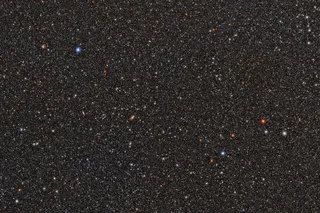


While looking out at the cosmos, it’s possible to see stars in a variety of colors, including red, white, orange, and blue. But you’re not likely to see any green stars, mostly due to the way the human eye processes light.
However, a new study published in the journal RAS Techniques and Instruments (RASTI) is taking a closer look at white dwarf stars and how they may emit more than the color green; they could be purple, pink, cyan, and yellow, too.
“Most stars, including most white dwarfs, behave like ‘perfect radiators,’ so their [color] is set almost entirely by temperature. But nobody had really looked into what else might be possible for white dwarfs,” said Mark Hollands, a Warwick Prize Fellow in the Astronomy and Astrophysics Group at the University of Warwick and lead study author, in a press release.
“It turns out these incredibly dense stars can produce [colors] nobody expected, and some of them genuinely surprised me," Hollands added.
Read More: First-Ever Binary White Dwarf System Destined to Explode as Type 1a Supernova
How Stars Form Colors

(Image Courtesy of Mark Hollands/University of Warwick)
When it comes to the colors stars emit, it turns out that some white dwarfs seem to bend the rules. The color of a star is based on a few factors, primarily its surface temperature, according to the study, with blue as the hottest and red as the coolest.

 Explore All Options
Another factor that can determine color is chemical composition and density when combined with the surface temperature, especially in white dwarfs. According to the study, density is key to determining white dwarf color. Some of the coolest white dwarfs can reach a density of about 1 gram per cubic centimeter. This is roughly the density of water.
Under these dense conditions, trace elements such as calcium, carbon, and sodium, which may be present, can interact with the dense helium plasma surrounding the star and absorb light in a wide array of colors that would be seen at a lower density. The colors then start to shift away from the typical oranges, blues, and whites.
White Dwarf Stars and the Color Green
Because there is no white dwarf close enough to Earth to be directly seen with the human eye, the research team needed to calculate what the color may look like instead. To achieve this, the team studied routinely collected data, including a star’s spectrum — the ‘fingerprint’ starlight produces when it is split apart by wavelength, similar to how a prism splits light into a rainbow.
The team then ran this data through a model of human color vision to reveal what color the star’s light would appear to us if we were close enough to it. The team noted that a spectrum can reveal a star’s temperature, chemical makeup, and its true colors.
After applying this method to white dwarfs across the cosmos, the team found that the stars’ colors fell into distinct groups, each linked to what the star’s atmosphere contains. Carbon-rich stars showed pink or purple hues, while those with atmospheres full of asteroid and comet debris, along with remnants of old planetary systems, appeared more yellow. Cooler stars with a mix of hydrogen and helium in their atmosphere appeared cyan or pale blue.
The researchers were most surprised by the white dwarf WD J1330+6435. With an atmosphere rich in lithium, sodium, and calcium, the star appeared chartreuse green, according to the team’s models. Per the press release, no other star has been credibly reported as green. This could be the first genuine green star in the galaxy.
“The traces of sodium in the atmosphere of this white dwarf absorb the orange part of the spectrum, leaving behind a ghostly green glow. Imagine standing on a planet and looking up at a green star. It feels like something out of science fiction," Hollands said.
The Most Red Star
The team may have also found the reddest star ever. WD J1011+2845 is only about 48 light-years from Earth and, thanks to the carbon molecules in its atmosphere, the star appears a deep salmon pink, unlike anything astronomers have seen before.
While the new colors are a fascinating discovery, most of the white dwarfs seen are still white, though if there is one green star out there, who’s to say there aren’t more?
Read More: Why Are There No Green Stars?
Article Sources
Our writers at Discovermagazine.com use peer-reviewed studies and high-quality sources for our articles, and our editors review for scientific accuracy and editorial standards. Review the sources used below for this article:
- This article references information from a study published in RAS Techniques and Instruments (RASTI): Any colour you like: The diverse chromaticities of white dwarfs