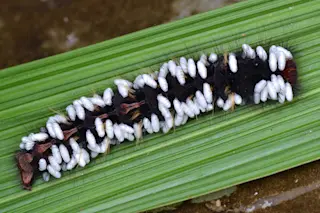



If you're a tobacco hornworm caterpillar, your own spit can come back to bite you: That plant you tried to eat for dinner can use your own saliva to summon larger animals that might like to make you their dinner. According to a study in Science, the tobacco plant has evolved a clever defense against hungry insects—it calls in the insects' predators for help:
When a leaf is wounded, plants immediately release a "bouquet" of distress chemicals known as green leaf volatiles (GLVs) into the air. GLVs are formed when long fatty acid chains in the cell membranes are chopped up into six-carbon molecules as a result of damage. These molecules can exist in two different shapes, or isomers, depending on the position of a double bond between two of the carbons [The Scientist].
What's cool, though, is that the tobacco plant gets personal when it's being devoured. Ian Baldwin and colleagues found that the plant gives off a different set of GLVs when it's damaged by a caterpillar than when it's damaged in other ways. The plant's chemicals, Baldwin says, seem to react with those in the caterpillar's saliva to create a signal that captures the attention of the caterpillar's predators.
"In effect, the caterpillar calls the police on itself," says Baldwin [New Scientist].
To be more specific, Baldwin's team found that those two isomers are responsible for the difference.
Mechanically injured plants release mostly (Z)-GLVs, isomers where the main chemical groups lie on the same side of a double bond. On the other hand, plants damaged by larvae of the tobacco hornworm (Manduca sexta), release a roughly equal mixture of (Z)-GLVs and (E)-GLVs, isomers where the main chemical groups lie on different sides of a double bond.
There is an energy barrier between the (Z)- and (E)-isomers, so some sort of catalyst is required for the chemical transformation to occur. Thus, something unique to the bite of the tobacco hornworm induces a rearrangement around the double bond of GLVs [Ars Technica].
For more about the tobacco plant's tricks, check out our previous
. Related Content: 80beats: Tobacco Plants Control Pollinators by Dosing Their Nectar With Nicotine
80beats: How the Tobacco Plant Outwitted the Hawkmoth
DISCOVER: Talking Plants
, on how they call for help DISCOVER: The Clever Tricks That Let Caterpillars Reach Butterflyhood
(photo gallery) Image: Wikimedia Commons