The Orion Nebula is one of the most familiar star-forming regions in the night sky, but the James Webb Space Telescope has now looked past that famous glow to a darker, colder place behind it.
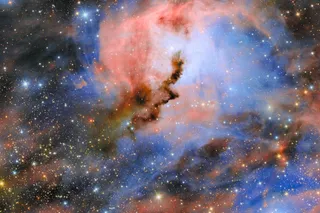
There, about 1,280 light-years from Earth, Webb captured part of OMC-2, a dense section of the Orion Molecular Clouds. The scene sits just north of the Orion Nebula, also known as M42, and shows gas, dust, young stars, and stellar embryos still hidden inside the cloud.
The image captures many stages of star formation in one place, from buried protostars to young stars already clearing away the material around them.
Webb Reveals Hidden Star Formation Behind the Orion Nebula
The Orion Nebula is only one part of a much larger star-forming complex called Orion A. Behind M42 lies a long filament of cold gas and dust divided into regions known as OMC-1 through OMC-4.
To visible-light telescopes, much of this region stays hidden. Thick gas and dust in and around the Orion Nebula block the view, while the dust inside OMC-2 obscures the youngest stars. Webb can see more because it observes in infrared light, which can pass through some of that dust.
Those young objects are protostars, the earliest stage in a star’s life. A protostar grows as gas from the surrounding cloud falls into a spinning disk around it. As the gas feeds the young star, it heats up and begins to glow.

 Explore All Options
Read More: NASA’s Roman Space Telescope Arrives in Florida Ahead of Late-Summer 2026 Launch
Protostars Blast Jets Through OMC-2
In Webb’s image, jets from young stars slam into surrounding gas and dust, creating shockwaves that heat the material and make it glow. Those collisions form bright ridges across the scene.
The jets also point back to some of the youngest stars in the region. Even when a protostar remains hidden inside thick dust, the glowing material streaming away from it can reveal where it is forming. Nearby, more developed young stars have cleared enough surrounding material to light up the gas and dust around them.
Infrared Light Turns Dust Into a Map of New Stars
Dark brown and black patches mark especially thick clumps of cold dust, where little or no light escapes. Orange, brown, and some red areas show warmer dust that absorbs light and emits some of its own. Yellow and green areas largely trace emission from polycyclic aromatic hydrocarbons, or PAHs, carbon-rich molecules often found in space. Blue and cyan hazes come mainly from starlight and protostar light scattered by dust grains. Red ridges mark gas heated by outflows.
The data come from Webb observing program 5804, which studies star formation in OMC-2 and nearby OMC-3. Because these molecular clouds are relatively close to Earth, astronomers can use them to study some of the earliest steps in stellar evolution.
Researchers will use Webb’s view to examine how outflows affect star formation, how ultraviolet light from young stars changes chemistry in the disks that may later form planets, and how gas and dust fall onto the many protostars in the region.
Webb’s view turns OMC-2 into a timeline of early star formation. In one image, stars are still gathering gas, breaking through dust, and beginning to reshape the cloud around them.
Article Sources
Our writers at Discovermagazine.com use peer-reviewed studies and high-quality sources for our articles, and our editors review for scientific accuracy and editorial standards. Review the sources used below for this article:
- This article references information from The European Space Agency: Webb unveils young stars across every stage of formation