In his computer models, Stephen Kane changed how quickly Venus spun and gave it hypothetical moons of different masses. He expected different outcomes, but kept encountering moons spiraling toward destruction.
The University of California, Riverside astrophysicist was investigating why a planet so similar to Earth in size and mass has no moon. His team explored whether a moon could have survived there if one had formed early in the planet’s history.
Their study, published in The Astrophysical Journal, describes how Venus may have swallowed its own moon. In some simulations, gravitational interactions sent a moon spiraling inward until the planet’s pull tore it apart. Its remains could then have fallen onto Venus, delivering a burst of energy that might have changed the planet’s surface, atmosphere, and ability to hold onto water.
“When I made this discovery, I was shocked,” Kane said in a press release. “I thought surely the broad range of scenarios I was exploring would lead to a variety of results. But it all went pretty much in the same direction.”
How Venus Could Lose a Moon
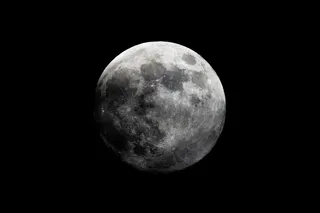
Kane first checked the model against Earth and its moon, reproducing their present-day changes closely. Our moon moves about four centimeters farther away each year as tidal interactions transfer energy from Earth’s rotation into its orbit. Earth’s spin gradually slows in the process.

 Explore All Options
A young Venus with a moon could have begun a similar exchange. In some simulations, the moon moved outward while its pull slowed the planet’s rotation.
But that slowing could change the moon’s direction of travel. If Venus took longer to complete a rotation than the moon took to circle the planet, tidal interactions would begin pulling the moon inward.
Eventually, it could reach the Roche limit, the distance where the planet’s unequal gravitational pull across the moon would tear it apart. Its debris could then fall onto Venus.
Some simulated moons survived for billions of years around an initially fast-spinning planet. Their fate also depended on how the models represented the response of Venus’s interior to tidal forces. The study therefore describes a possible history for a lost moon, rather than evidence that Venus definitely had one.
What Losing a Moon Could Mean for Venus
Before its destruction, a large moon could have helped steady the tilt of Venus’s axis, influencing how sunlight reached the surface. If the planet had oceans, the moon would also have raised tides that moved water and redistributed heat.
Its loss could remove that steadying influence while delivering a burst of energy to the surface and atmosphere. The authors propose that such an event might have contributed to the loss of water or a runaway greenhouse climate, in which warming and heat-trapping water vapor reinforce each other.
That gives researchers another possibility to investigate as they reconstruct how Venus became so different from Earth. The simulations trace the moon’s motion; the climate consequences remain questions for further research.
Searching for What a Moon Left Behind
Finding evidence on the ground would be difficult. Geological activity has renewed much of Venus’s surface since its earliest history, potentially covering traces of fallen debris.
The study proposes looking for chemical clues in the atmosphere instead. Measurements by NASA’s DAVINCI mission could potentially help test the idea, although researchers would first need to determine what traces lunar debris might leave and how to distinguish them from volcanic activity and atmospheric loss.
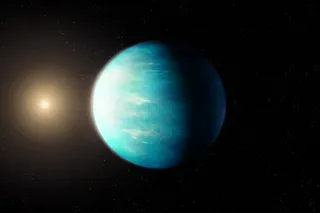
For Kane, the question also reaches planets around other stars. A rocky world could form a moon, then lose it as their gravitational interaction changed both bodies’ movements.
“When people think about Earth twins around other stars, one question they ask is, ‘Does it have a moon?’” Kane said.
His work raises the possibility that a moonless planet once had a companion that helped shape its history, then became part of the planet itself.
Read More: First Diagnostic X-rays in Space Mark a New Era for Astronaut Health
Article Sources
Our writers at Discovermagazine.com use peer-reviewed studies and high-quality sources for our articles, and our editors review for scientific accuracy and editorial standards. Review the sources used below for this article:
- This article references information from a study published in The Astrophysical Journal: Tidal Demise: The Evolution and Fate of a Hypothetical Venus Moon