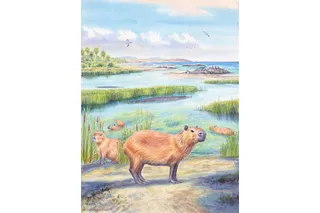
Payton Kohlberg and Allison Sefcovic have quite a bit in common: both were 2025 Women in Science interns at the Field Museum, both work in the same paleontology lab — and both have mothers named Jean. So when the two student scientists described a new 309-million-year-old relative of today’s amphibians from Illinois, they named it Jeanerpeton: “Jean’s crawler.”
An amateur collector found the fossil years ago at Mazon Creek in Illinois, a former river delta where mud covered dead animals before their finer features disappeared. The collector donated it to the Field Museum, which classified it as a species already known from the area. Kohlberg and Sefcovic’s closer examination suggested it was a different animal altogether. Their findings were published in the Journal of Vertebrate Paleontology.
“What's really cool about Mazon Creek is that it preserves all of these unusual details — things like toe pads and body outlines,” Sefcovic said in a press release. “In the fossil of Jeanerpeton, we can see some of the scales on its back and tiny ‘belly ribs’ called gastralia. You can even see the eye impressions! It's so cool to see.”
How a Mazon Creek Fossil Became Jeanerpeton

Fossil and illustration of new species Jeanerpeton mazonensis
(Image Credit: Allison Sefcovic)
The specimen’s old name was Amphibamus grandiceps, an ancient amphibian relative already documented at Mazon Creek. In a separate 2020 study published in the Journal of Vertebrate Paleontology, Arjan Mann, who leads Kohlberg and Sefcovic’s lab, and vertebrate paleontologist Bryan Gee examined the fossil’s toe pads.

 Explore All Options
They noted that it had a different number of vertebrae from A. grandiceps, but did not give it a new species name. The latest paper formally describes it as Jeanerpeton mazonensis. The second half of its name, mazonensis, refers to Mazon Creek.
Co-author Cam So said A. grandiceps had become a catchall label for several fossils in the Field Museum’s collection. Examining them individually could show that some belong to separate species. Paleontologists call a grouping like this a “waste bin taxon.”
“With this publication, we officially pull Jeanerpeton out of this waste bin taxon,” So said.
Read More: These Invasive Frogs Were Once Used as Pregnancy Tests — Now They're Carrying a Deadly Fungus
What Its Toe Pads Tell Researchers
Jeanerpeton had a squat, chubby, salamander-like shape and toe pads that Mann and Gee compared with those of living amphibians. In their 2020 paper, they reported the first evidence of such pads in a temnospondyl body fossil.
Temnospondyls were an extinct group of four-legged animals that included Jeanerpeton. Mann and Gee found that its broad toe tips differed from the thinner, tapered toes of aquatic relatives. Some amphibians alive today use toe pads to grip surfaces, but the fossil cannot tell researchers whether Jeanerpeton climbed or how else it used its feet. The pads do show that a feature seen in living amphibians was already present more than 300 million years ago.
What the Project Meant to Kohlberg
The Field Museum runs its Women in Science internship to encourage young women to pursue careers in science and museums.
“Before working in the Mann Lab, I didn’t know much about paleontology,” Kohlberg said in the press release. “My experience at the Field and in the Women in Science program has made me more confident in my abilities to try something new. It is scary to take on a project when you feel like you don’t know as much as you should, but I learned with my practical experience that it is possible to overcome that fear with hard work.”
Read More: A Small Genetic Shift May Have Launched Vertebrate Evolution
Article Sources
Our writers at Discovermagazine.com use peer-reviewed studies and high-quality sources for our articles, and our editors review for scientific accuracy and editorial standards. Review the sources used below for this article:
- This article references information from a study published in Vertebrate Paleontology: Jeanerpeton mazonensis, gen. et sp. nov.: a new, exceptionally preserved, late Carboniferous amphibamiform from the Mazon Creek Lagerstätte, Illinois
- This article references information from a study published in Vertebrate Paleontology: Lissamphibian-like toepads in an exceptionally preserved amphibamiform from Mazon Creek