When someone calls your name, tiny hair bundles inside your ears move with the sound. Damage to them can cause hearing loss, and researchers are studying cells with similar bundles on the skin of a squid to better understand how they work.
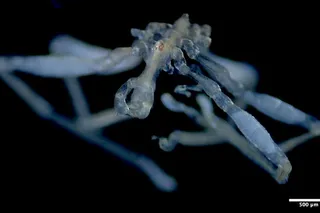
A team at Case Western Reserve University has mapped these sensory hair cells across the squid’s body, finding them in places where they had not been described before, according to a study in Current Biology. The cells appear to sense water movement, and their bundles differ in length from one part of the body to another. That variation may help them pick up different kinds of movement, much as the structures in our ears help us tell pitches apart.
“Squid are cephalopods with a diverse population of hair cells on the surface of their bodies, which may yield insights not only into how these fascinating animals detect water movement to survive, but also into how hearing and deafness occur in humans,” said Brian McDermott, senior study author, in a press release.
Mapping Sensory Hair Cells Across a Squid’s Body
Squid were already known to have rows of sensory hair cells, called lateral lines, on their heads and arms. Fish have them too, along the head and body. What no one had described in detail was how the rest of a squid’s skin picks up water movement.

 Explore All Options
The team imaged hatchlings of a species called Doryteuthis pealeii, the longfin inshore squid (which you may have eaten as calamari), under a light sheet microscope. A laser spreads into a flat sheet of light that lights up a single slice of the animal, and the slices combine into a 3D image with little harm to the specimen.
Hair cells turned up far beyond the head and arms, some lined up in tight rows, while others covered wide areas of skin in a layout that had not been seen before in any squid or fish. They crowded the edges of the fins, dotted the mantle, which is the muscular body wall, and ran along the siphon, the tube a squid squirts water through to jet along.
Newly hatched squid are covered in temporary hairs that have no sensory role and fall off within a day or two. The team checked animals of different ages to make sure they were mapping lasting sensory bundles, and found them on the mantle of adult squid too.
Read More: People Have Heard an Unexplained Hum for 50 Years — It May Be Coming From Inside Their Own Heads
Different Hairs for Different Movements
Length varied too, as bundles at the front edge of the mantle were about a fifth as long as those on the head.
In the human ear, a cell's pitch depends partly on the height of its bundle, with tall ones catching low sounds and short ones catching high sounds. The lengths in fish lateral lines do not vary in the same way, while squid appear to set a cell's sensitivity partly through bundle length.
Short bundles at the mantle's opening may watch the water flowing in for breathing and jetting, while longer ones on the head and arms may suit slower movements. Almost none sit under the head where jets leave the siphon, which the team suggests may stop a squid's own jets from drowning out its sensors.
What Squid Could Reveal About Human Hearing
Bundles in the human ear are built on a protein called actin, and squid bundles are built on microtubules, which are tiny tubes inside cells. They do related jobs with different parts, so the likeness has limits.
Still, the authors say the squid's varied bundle lengths make it a useful stand-in for studying how hearing works. The paper itself does not test hearing.
“Often, when a child is born deaf or a hearing person loses their hearing, it is the hair bundle that has been damaged,” McDermott concluded in the press release. “So, studying the squid's hair bundle holds promise for understanding how hearing loss occurs.”
Read More: Rare Arctic Bobtail Squid Filmed With Eggs in Remote Greenland Waters for the First Time
Article Sources
Our writers at Discovermagazine.com use peer-reviewed studies and high-quality sources for our articles, and our editors review for scientific accuracy and editorial standards. Review the sources used below for this article:
- This article references information from a study published in Current Biology: An anatomical map of squid lateral lines