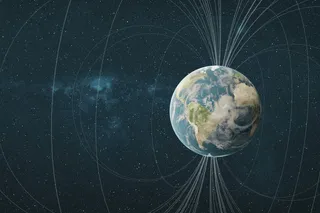


For a little over 50 years, the time that the whole world runs on has been occasionally adjusted with leap seconds. The purpose of these leap seconds is somewhat similar to leap days: Both are meant to keep time measurements synchronized with the movements of Earth. But leap seconds are now destined to become a thing of the past, as the international timekeeping body that manages Coordinated Universal Time (UTC) has voted to officially abolish them.
On Thursday, October 15, representatives from 69 countries approved a motion to do away with leap seconds during the General Conference on Weights and Measures in Versailles, France. This decision, set to go into effect in May 2027, was prompted by concerns that keeping leap seconds could eventually induce catastrophic disturbances in global computing systems and telecommunications networks.
Find out why leap seconds have been controversial in recent years, and what will happen now that they’re soon to be obsolete.
Read More: Seeing 16 Sunrises in 24 Hours, Astronauts Need Different Ways to Tell Time in Space
Clash of the Times
Humans have long relied on natural observations for timekeeping, using phases of the moon and shadows cast by the sun to measure time. Timekeeping devices evolved throughout the years, from ancient sundials to mechanical clocks.

 Explore All Options
But by the 1950s, scientists introduced a new innovation that could measure time with unprecedented precision: the atomic clock. The cesium atomic clock, in particular, set the standard for timekeeping, but it doesn’t measure time based on astronomical movements; it instead uses the vibration of the cesium-133 atom, leading scientists to define a second as the duration of 9,192,631,770 periods of the chosen vibration of the atom, according to the National Physical Laboratory.
This definition of a second serves as the foundation of International Atomic Time (TAI).
TAI is constantly at odds with Universal Time 1 (UT1), which is the definition of time based on Earth’s rotation angle relative to distant stars. At first, when TAI was introduced in 1958, the two time scales were approximately equal, according to Markus Kuhn, a computer scientist at the University of Cambridge. The problem, though, is that Earth’s rotation is irregular; since it has been slowing down over the long term, UT1 has fallen behind the more precise atomic measurements of TAI.
With the two time scales growing more and more off-balance, international timekeepers had to devise a solution. That solution would be leap seconds.
The Purpose of Leap Seconds
To rectify the discrepancy between TAI and UT1, timekeepers established Coordinated Universal Time. UTC uses atomic measurements like TAI, but every once in a while it needed to have leap seconds added.
Leap seconds had been added to UTC — usually in the last minute of either December or June — to make sure the difference between its time and UT1 never exceeds 0.9 seconds. According to Kuhn, leap seconds were needed almost every year in the 1970s and 1980s, and on average every 1 to 2 years after, to balance out the difference between UTC and UT1.
However, no leap seconds were needed from 1998 to 2005 because of an unusual temporary acceleration of Earth. Even though the Earth has been slowing down over the long term, it has slightly accelerated in recent years, with the last leap second needed back in 2016.
From Leap Second to Leap Hour
Adding a leap second to UTC may sound like an innocuous adjustment, but in reality, it’s been much more contentious. According to the U.S. National Institute of Standards and Technology, adding a leap second can create problems for some systems, such as data-logging applications, telecommunications systems, and time-distribution services.
In 2012, for instance, the high-resolution timer of the Linux kernel (the main component of a Linux operating system) mishandled the addition of a leap second, causing widespread outages that affected Reddit, Mozilla, Yelp, and LinkedIn, as well as digital infrastructure for many airlines.
Recent increases in Earth’s rotation could also theoretically require a “negative” leap second to be implemented — rather than adding a second, timekeepers would need to remove a second to keep UTC and UT1 in alignment. Such an adjustment could bring more chaos to global systems than debacles like the 2012 outages.
The mounting issues associated with leap seconds gave timekeepers the push to abolish them. But what now?
Leap seconds will be replaced with a leap hour; timekeepers will now let the difference between UTC and UT1 add up until it reaches 3,600 seconds, or one hour. Only then will clocks be adjusted, and it may be several hundred to a thousand years before this even happens.
Read More: How Could Atomic Clocks Be Used to Detect Dark Matter?
Article Sources
Our writers at Discovermagazine.com use peer-reviewed studies and high-quality sources for our articles, and our editors review for scientific accuracy and editorial standards. Review the sources used below for this article:
- This article references information from the General Conference on Weights and Measures: 28th meeting of the CGPM
- This article references information from the National Physical Laboratory: What is a leap second?
- This article references information from the University of Cambridge: Leap seconds
- This article references information from the U.S. National Institute of Standards and Technology: Leap Seconds FAQs