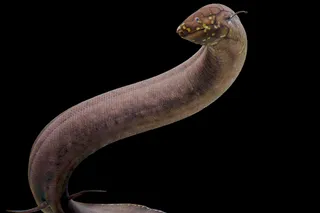


For the spider-tailed horned viper, capturing prey involves a clever trick of the eye. The genius of this desert-living snake’s hunting strategy is right in its name; it uses its tail — which happens to look like a spider with a bulbous body and dangling legs — to lure birds into swooping down for a quick arachnid snack, and go in for the kill when a bird gets close.
For decades since the snake’s discovery, scientists weren’t sure what the inside of its faux-spider tail looked like. But now, a new study published in The Anatomical Record has an answer, supported by X-ray images of a spider-tailed horned viper specimen: It turns out that the snake’s vertebrae are surprisingly normal. The spider-like features of the tail are purely made of scaly skin, and not actually an evolutionary development in the skeleton, illustrating how bones don’t always tell the full story of an animal.
“We work with beautiful animals, but most of the time, we’re trying to put together puzzles with some of the pieces missing, and in the end, we can’t be 100 percent sure of what the animal actually looked like,” said study first author Georgios Georgalis, an associate professor at the Polish Academy of Sciences, in a statement.

 Explore All Options
A Snake With a Fake Spider on Its Tail
Researchers collected the first specimen of the spider-tailed horned viper in 1968 on an expedition to Iran, and then sent it to the Field Museum in Chicago, where it would be further examined in 1970.
At first, the researchers thought a small solpugid (a type of sun spider) was clinging to the snake’s tail, according to a 2006 study in the Proceedings of the California Academy of Sciences. Upon closer inspection, they realized that what they thought was a spider was actually a peculiar growth. They still didn’t know, however, whether this growth had a genetic origin, was some sort of tumor, or was caused by a parasite.
In 2003, a second specimen with a similar tail was found. This led researchers to later classify the snake as a new species, the spider-tailed horned viper (Pseudocerastes urarachnoides), in the 2006 study. It's now known that the species is endemic to western Iran and a small part of the eastern Iraq border, living in the Zagros mountain range.
Read More: Thousands of Snakes Close This Illinois Road Twice a Year as They Move Between Seasonal Habitats
Scanning a Snake Holotype
Not long after the spider-tailed horned viper was described as a new species, researchers captured a video of the snake using the spider-like appendage at the tip of its tail — referred to as a caudal lure — as bait for birds.
“The appendage at the end of its tail is so outrageous, I remember thinking it was so cool. It’s truly unique among snakes,” said the new study's co-author Sara Ruane, the associate curator of herpetology and director of Core Laboratories at the Field Museum.
The researchers involved with the new study wanted to take a look inside the specimen held at the Field Museum, which is considered the holotype, or the official representative of a scientifically documented biological species, according to the Field Museum. In particular, they were interested in the snake’s vertebrae.
“In some other snakes, like sand boas and rubber boas, the vertebrae at the tip of the tail have extreme shapes that look really alien. We wanted to investigate if the spider-tailed horn viper’s tail was similarly strange inside,” said Georgalis.
Normal on the Inside
In late 2024, the researchers got a chance to scan the spider-tailed horned viper holotype and take X-ray images in the Field Museum’s XCT (X-ray computed tomography) lab, which had only recently begun operations.

X-ray of the spider-tailed horned viper.
(Image Credit: Sara Ruane and Stephanie Smith)
This revealed that the vertebrae inside the tail looked like typical viper vertebrae; by looking at these bones alone, you wouldn't have any idea that the spider-tailed horned viper has such an odd appendage at the tip of its tail.
The researchers say that this study serves as a reminder that there may be more to organisms than their bones would suggest, especially when it comes to prehistoric life. Knowing that the spider-tailed horned viper's tail is simply made of skin could also shed light on how the body tissues of snakes evolve and develop.
Read More: This Snake Rolls at 8 Miles Per Hour to Escape Predators, but Its Head Stays Pointed Forward
Article Sources
Our writers at Discovermagazine.com use peer-reviewed studies and high-quality sources for our articles, and our editors review for scientific accuracy and editorial standards. Review the sources used below for this article:
- This article references information a study published in The Anatomical Record: Vertebral morphology and intracolumnar variation of the iconic and bizarre viperid snake Pseudocerastes urarachnoides (Serpentes, Viperidae)
- This article references information from a study published in Proceedings of the California Academy of Sciences: A new species of Pseudocerastes with elaborate tail ornamentation from western Iran (Squamata: Viperidae)
- This article references information from the Field Museum: Holotypes across the Sciences