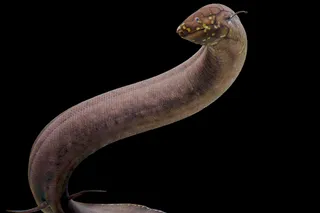
For a small snake trying to escape a predator, the ground can become a racetrack. But instead of slithering toward safety, a dwarf reedsnake puts its body through something closer to an acrobat’s routine — rolling forward, swinging its body around, and repeating the maneuver at remarkable speed.
Watch its head, though, and the performance becomes even stranger. While the rear of the snake rotates, its head stays pointed toward its destination. Somehow, all that movement produces a steady ride up front.
A study published in Current Biology explores how these snakes pull it off. The findings reveal an escape strategy that depends on carefully coordinated movements and show why a snake’s shape tells only part of the story of what it can do.
How Fast Can Dwarf Reedsnakes Roll?
Dwarf reedsnakes belong to the genus Pseudorabdion and live in Southeast Asia. They are among the few animals known to actively roll to evade potential predators.
Their unusual getaway had appeared in field guides and earlier observations, but the mechanics remained poorly understood. Seeing a snake roll is one thing — untangling what each part of its body is doing is another.
To get a clearer picture, researchers recorded the snakes from several angles and examined their movements in detail.

 Explore All Options
During rolling, the snakes reached peak forward speeds of 1.72 to 3.69 meters per second, or roughly 3.8 to 8.3 miles per hour. That was about four times the peak speed measured during lateral undulation, the familiar movement in which snakes bend their bodies from side to side to slither.
Speed also didn't come at the expense of staying on course. The snakes successfully moved along a racetrack just 7.8 inches wide while rolling.
Read More: Thousands of Snakes Close This Illinois Road Twice a Year as They Move Between Seasonal Habitats
The Body Movements Behind a Rolling Escape
Rolling sounds straightforward until you consider what happens to the head.

Cartoon on how dwarf reedsnakes roll.
(Image Credit: Yosuke Kojima, Kanon Tanaka)
A wheel can turn around an axle while the vehicle it carries stays upright. An animal has no equivalent separation. If its whole body tumbles, its head and sensory organs go along for the ride, potentially making it harder to track its surroundings and control its movement.
Dwarf reedsnakes manage the problem through a repeating sequence of alternating motions.
First, the snake rolls with one side of its body against the ground. It then swings an arched portion of its body downward beside its head, a movement the researchers call a “stroke.”
On the next cycle, the opposite side contacts the ground, and the stroke switches direction. Repeated left-right alternations keep the snake rolling forward.
What initially looks like a frantic tumble is actually a coordinated series of movements, with different body regions doing different jobs.
Why Keeping the Head Steady Matters
Throughout this routine, the head remains directed forward while the rear of the body rotates rapidly. Its height above the ground also stays relatively consistent.
At faster rolling speeds, the snakes tend to hold their heads elevated and limit their up-and-down movement. That steadiness may help them maintain control during a rapid escape, although the proposed benefit is an interpretation of the observed movements.
The broader lesson reaches beyond one unusual snake maneuver. These animals achieve something resembling the functional separation of a wheel and axle through body control alone — one region rotates extensively while another stays stable.
For a predator, that could mean a surprisingly quick departure. For researchers, it is a reminder that understanding an animal’s abilities requires watching how it uses its body, not simply examining its shape.
Read More: Typhoon Flooding in China Sends Farmed Venomous Snakes Swimming Into Residential Areas
Article Sources
Our writers at Discovermagazine.com use peer-reviewed studies and high-quality sources for our articles, and our editors review for scientific accuracy and editorial standards. Review the sources used below for this article:
- This article references information from a study published in Current Biology: Locomotor kinematics and head stabilization in rolling snakes