

What do the Great Sphinx and the newly discovered extinct crocodile species have in common? They’re both from Egypt; they both come from the same stone, and the biggest thing? They’re each missing their nose.
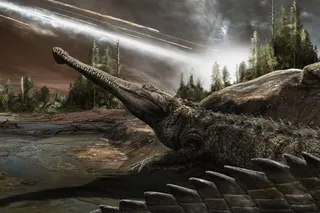
An international research team led by the Swedish Museum of Natural History in Stockholm recently analyzed fossils from the Mokattam Formation in Egypt — the same formation the stone used for the Great Sphinx came from — and identified a new species of ancient crocodile.
A new study published in the Royal Society Open Science has identified this fossil, previously believed to be part of the genus Tomistoma, as a new species and has finally given this long-lost crocodile a name.
Read More: This 215-Million-Year-Old Crocodile Was Built to Run, Not Swim
Naming an Ancient Crocodile
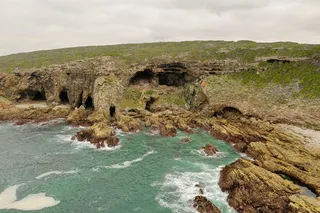
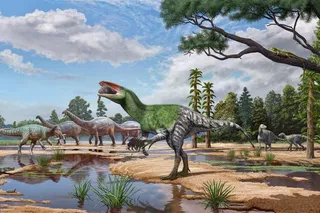
The Mokattam Formation in Egypt is about 45 million years old and home to a variety of fossils. According to the study, paleontologists recovered several fossils in the 1920s, including the newly identified crocodile species.
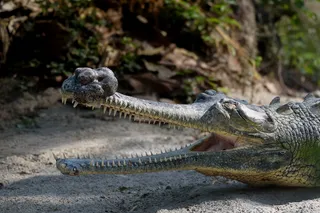
One fossil was a near-complete skull of what appeared to be an ancient species of Tomistoma crocodile, part of the gavial group. Gavials are characterized by long, thin snouts, and only two species exist today: Gavialis gangeticus — known as the gharial — and Tomistoma schlegelii — known as the ‘false gharial.’

 Explore All Options
Although only two species remain today, gavial fossils span the fossil record and date back over 100 million years. Researchers have also uncovered gavial fossils from all over the globe.
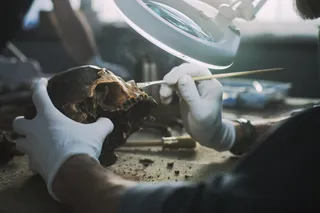
The skull researchers uncovered has a snout similar to that of the false gharial, and researchers grouped the fossil with Tomistoma until modern technology like CT scanning gave researchers a better look. After noting several differences and the coincidence that the fossil was missing the tip of its nose, similar to the Great Sphinx, the research team settled on the name Herugavialis cairensis.
“Given this coincidence with the famously missing nose of the Great Sphinx, we decided to name the new crocodile after the Egyptian god Heru, who was possibly the inspiration for this iconic monument,” Philip Mannion of University College London, who co-led the study, said in a press release.
The Ancient Crocodiles of Egypt
H. cairensis, like many ancient crocodile species, enjoyed shallow marine environments. From what researchers can tell, there were two additional gavial species that likely shared these environments in Egypt at the time.
“Throughout much of the last 50 million years, the Mediterranean region hosted a high diversity of crocodiles, including gavials,” lead author Paul Burke said in the press release. “However, this diversity fluctuated over time, seemingly corresponding to changes in global temperature and sea level, before the loss of all crocodiles in this region as a result of the drying of the Mediterranean approximately 6 million years ago.”
While a variety of crocodile species once lived in the area, only one remains today. The Nile crocodile is the only one commonly found in Egypt today, according to the Natural History Museum of Utah.
How Did the Great Sphinx Lose Its Nose?
Ancient Egyptians carved the Great Sphinx from limestone, likely during the reign of King Khafre, circa 2472 B.C.E. to 2448 B.C.E., according to Britannica, though his brother may have built it. The sphinx depicts the king’s face and is an iconic monument.
Although the monument has faced centuries of erosion and weathering, the Great Sphinx’s nose may not have fallen off due to natural causes. Some speculate that Napoleon’s troops shot the nose off with a cannon, though there is evidence to show that the nose may have been gone before that, according to Britannica.
While researchers likely know what happened to the Great Sphinx’s nose, they are still unsure how H. cairensis lost its own. That mystery will have to be solved another day.
Read More: As Masters of Survival and Evolution, the Crocodile Now Has Two New Species
Article Sources
Our writers at Discovermagazine.com use peer-reviewed studies and high-quality sources for our articles, and our editors review for scientific accuracy and editorial standards. Review the sources used below for this article:
- This article references information from a study published in Royal Society Open Science: Cranial anatomy of the Middle Eocene Egyptian crocodylian Herugavialis cairensis provides new insights into gavialoid diversity in the Mediterranean region
- This article references information from Britannica: Great Sphinx of Giza
- This article references information from the Natural History Museum of Utah: Egypt's Nile Is Home to a Special Crocodile