

A minor cut or scrape on our skin takes at least a few days to heal, but for one jellyfish, small wounds can close in mere minutes. This unbelievable healing ability of the jellyfish Clytia hemisphaerica has caught the eye of scientists, who have now identified the reason why this species can patch itself up so quickly.
If you were to spot the transparent adult form of Clytia with a wound, you’d be able to see the wound heal in real-time. This is made possible by the intricate movements of structures that allow protective cells to “walk” across a wound, a process that researchers describe in a new study published in Molecular Biology of the Cell. Wound healing in Clytia may even shed light on how other animals beyond jellyfish heal.
“This is a truly elegant mechanism where the system can rapidly adapt to heal all the kinds of wounds that might occur in nature,” said Jocelyn Malamy, an associate professor in molecular genetics and cell biology at the University of Chicago, in a statement.
An Unusual Jellyfish Lifecycle
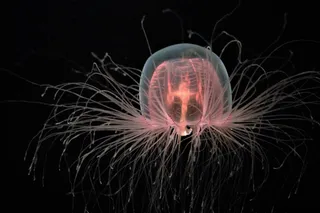
When you picture a jellyfish, you probably imagine a floating creature that looks somewhat like an underwater apparition. But not all jellyfish start out looking like this. Many, like the dime-sized Clytia and other hydrozoans, start as polyp colonies attached to submerged rocks or other hard surfaces.

 Explore All Options
Eventually, the polyps release medusae, the free-swimming umbrella-like forms that we usually associate with jellyfish. Adult medusae live only for a few months, but the polyp colonies that spawn them stay around indefinitely.
Even though Clytia medusae don’t live for long, their wound healing is remarkable. Small wounds heal in minutes, and larger wounds heal in less than an hour; the wounds also don’t leave scar tissue.
Read More: Box Jellyfish Venom Punctures Cells, Disrupts the Heart, and Can Kill Within Minutes

Clytia epithelial cells.
(Image Credit: Jocelyn Malamy)
Walking to Repair Wounds
The new study found that epithelial cells — which line the body’s surfaces in jellyfish and humans alike — heal wounds in Clytia through two structures. The first, called lamellipodia, are foot-like feelers that move with a fluid motion, like amoebas. These structures extend out of cells at the edge of wounds and move across the basement membrane, which is the protein sheet that lies underneath all epithelial cells.
As the lamellipodia move, they drag the cells that produced them forward until the cell body is stretched over a wound. But the lamellipodia aren’t the only helpers to administer this cellular bandage.
A second structure, an actomyosin cable, emerges near the back of the lamellipodia and contracts when the feelers cover the wound. According to Malamy, this cable helps stretch cells over the basement membrane if the lamellipodia encounter obstacles like debris or a tear in the membrane.
This process works smoothly for small wounds, but some adjustments are needed for larger wounds. In this case, the lamellipodia can’t stretch their cells enough to meet each other, and so epithelial cells have to collectively migrate to close the wound.
Visible Healing
Wound healing is easy to see in Clytia, not just because it's transparent, but also because it experiences no inflammation around a wound, unlike mammals. Researchers can easily see what the jellyfish’s epithelial cells are doing to sew a wound back together.

Two small wounds in the sheet of epithelial cells.
(Image Credit: Jocelyn Malamy)
Surprisingly, though, wound healing in Clytia has many of the same fundamental traits as wound healing across the animal kingdom.
“When you're staring at these epithelial cells, you wouldn't know this was a jellyfish. It could be any kind of squamous epithelial cell sheet, and that's nice, because it means that hopefully what we learn in jellyfish can give us insights into other animals as well,” said Malamy.
The next step in studying wound healing in Clytia will be to find out how the jellyfish fully repairs its basement membrane following the temporary patchwork done by epithelial cells.
“It's great that you can heal a wound by dragging the cells over it,” Malamy said, “but at some point, a damaged basement membrane has to get fixed.”
Read More: New Species of Box Jellyfish Found Off Singapore — and It’s Highly Venomous
Article Sources
Our writers at Discovermagazine.com use peer-reviewed studies and high-quality sources for our articles, and our editors review for scientific accuracy and editorial standards. Review the sources used below for this article:
- This article references information from a new study published in Molecular Biology of the Cell: The basement membrane determines the choice of wound healing mechanism across wound scales in the basal eukaryote Clytia hemisphaerica