

A severed piece of sea cucumber didn’t seem like a very interesting specimen for a group of scientists. Then, weeks later, they noticed something surprising — not only had the severed piece not died, but it appeared to be growing.
It sounds like the premise of a science fiction story, but researchers found that amputated tissue from cold-water sea cucumbers — which they are calling “real-life zombies” — remained alive and growing for more than three years in ordinary seawater.
The findings, published in Science Advances, challenge assumptions about how tissues survive outside the body and hint at future possibilities in regenerative medicine, tissue engineering, and biological research.
“We haven’t grown a new, complete sea cucumber yet, but we are seeing pretty stunning growth and diversification of cells literally years after this tissue was removed,” said oceanographer Rachel Sipler in a press release. “It’s like a lizard that loses its tail. We know some lizards can grow new tails; we’re talking about whether the tail can grow a new lizard.”
Meet the Real-Life Zombie Sea Cucumber
The star of this study is Psolus fabricii, a cold-water species of sea cucumber that lives on the seafloor. While sea cucumbers may not seem particularly glamorous, they belong to a fascinating animal group called echinoderms, which also includes sea stars and sea urchins — creatures already famous for their ability to regenerate lost body parts.

 Explore All Options

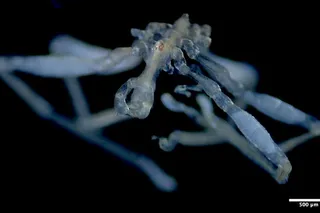
A comparison of live sea cucumber tube foot tissue shows healing and new growth after being removed.
(Image courtesy of Sara Jobson)
Scientists have long known that many echinoderms can repair damaged tissue and regrow structures. But they had not expected discarded tissue to show the same kind of resilience.
Then one day, researchers noticed that tissue removed from a sea cucumber’s tube foot — a tiny appendage used for movement and feeding — wasn’t decaying after weeks in seawater. Instead, it seemed to be thriving.
How Severed Sea Cucumbers Kept Growing
To better understand what was happening, researchers tested tissue taken from the feet, body, and tentacles of three sea cucumbers. Rather than placing the samples in a sterile lab environment, the team exposed them to flowing natural seawater.
“Natural seawater is just about the most microbially diverse, least clean approach we could take experimentally. Yet, that rich environment full of bacteria and all this organic matter was actually feeding them and allowing this tissue to heal and grow,” explained Sipler.
Scientists observed signs of immune activity, tissue restructuring, and specialized cells diversifying over time. Somehow, even without a mouth or digestive system, the tissue appeared capable of absorbing dissolved amino acids directly from seawater to sustain itself.
Most remarkably, the tissue stayed biologically active for over three years and likely would’ve kept growing. Researchers only ended the experiment because they were ready to publish their findings.
How This Discovery Could Impact Future Research
Researchers believe this sea cucumber tissue could become a valuable experimental model for biomedical science because it survives in conditions that would destroy many traditional cell cultures. That resilience may help scientists explore everything from tissue regrowth and wound healing to antimicrobial therapies.
There are some practical advantages, too. Since the tissue can be grown relatively easily and comes from an invertebrate, it avoids some of the ethical and biosafety hurdles associated with human or vertebrate cell lines. That could make biological research more accessible in the classroom and labs with limited resources.
Overall, the discovery truly shows how little scientists still know about ocean life and what breakthroughs might be hiding beneath the waves.
“The best advances in science are made when you find a natural analog for what you’re studying. Here is this species that has this groundbreaking ability, and we had no idea. It’s a reminder how much is yet to be discovered in the marine environment, and how important it is to protect these resources that may hold really valuable knowledge for us,” concluded Sipler.
Read More: A 3D-Printed Elephant Inside a Living Cell Signals a Bioengineering Breakthrough
Article Sources
Our writers at Discovermagazine.com use peer-reviewed studies and high-quality sources for our articles, and our editors review for scientific accuracy and editorial standards. Review the sources used below for this article:
- This article references information from a study published in Science Advances: Natural tissue immortality: Indefinite survival of sea cucumber explants