Millions of years ago, vertebrates underwent a major evolutionary transition that gave them limbs. Those tetrapods could finally expand into new environments by moving into and adapting to all the varied ecosystems of our planet. However, there are still a lot of uncertainties around how this fundamental transformation in tetrapod ancestry occurred.
By taking a closer look at a 345-million-year-old fossil found 30 years ago in Scotland that has famously been named “Lizzie,” commemorating its lizard-like appearance, researchers from the American Museum of Natural History and the University of Oxford suggest that new clues are filling parts of the knowledge gap around tetrapod ancestry.
The researchers are now questioning Lizzie’s categorization as the earliest land-adapted amniote, the vertebrate group that includes reptiles, in their new study published in Nature.
“Lizzie has been an icon for the early evolution of amniotes for decades,” said study co-author Xavier Jenkins from the Museum’s Division of Paleontology in a news statement. “But when we were finally able to see inside the fossil, we found an animal that looked very different from what we expected.”
Read More: Pivotal Ancient Fish Fossils Mark a Key Turning Point in a Slow Evolution
X-Ray Scans Reveal Lizzie Had a Fish-Like Mouth and Gills

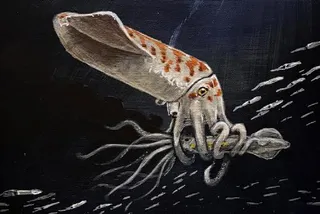
Westlothiana reconstruction based on x-ray scans of the fossil
(Image Credit: © AMNH)
The ancient fossil, given the official name Westlothiana lizziae, was different from many other fossils from the same time. By looking at what’s visible on the surface of Lizzie’s fossilized remains, researchers could see an almost complete skeleton with four limbs and claws on its toes. This stood in stark contrast to the common fin-like limbs found in other fossils, making Lizzie a landmark fossil when it came to pinpointing the timing of amniote evolution.

 Explore All Options
Using X-rays, the research could finally take a look inside the rock to better understand Lizzie’s anatomy that had previously been hidden. Now the team could see Lizzie’s skull and a jaw serrated with thousands of small teeth, as well as remains of gills, all traits that better represent a fish-like, aquatic or amphibious creature instead of a terrestrial reptile.
“The surprisingly primitive features of the skull show us that Lizzie was not only not a reptile but belonged to a much more ancient lineage,” explained co-author Ben Igielman from the University of Oxford in the news release. “It turns out looks can be deceiving, and Lizzie lived a completely different lifestyle than we previously thought.”
Lizzie Gets a New Spot in the Taxonomic Hierarchy
During the Early Carboniferous, when Lizzie roamed the Earth, many species emerged with fin-like limbs or had lost them again, raising questions about the exact ecological context that allowed the final emergence of the tetrapod limb.
Based on the new findings from Lizzie’s fossil, the researchers are suggesting that Westlothiana possibly evolved earlier than previously thought and lived an aquatic lifestyle, placing it further up in the tetrapod lineage, which includes not only land-adapted amniotes but also amphibians.
“This is a big surprise,” said study co-author Roger Benson, the Museum’s Macaulay Curator of Paleontology, in the statement. “It shows that, although we think of amphibians as being more ‘primitive’ than reptiles today, some of the traits of reptiles were already there in the ancestor of both amphibians and reptiles.”
Rethinking Labeling Ancient Species That First Walked the Earth
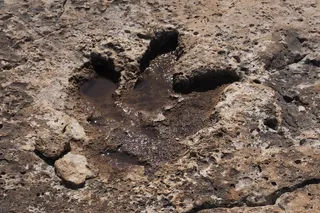
Reevaluating Lizzie’s spot in the taxonomic lineage also aligns with recent suggestions based on fossil trackways that amniotes were already around 356 million years ago. The trackways show ancient “footsteps” of an animal walking on four clawed limbs, similar to Westlothiana.
Taken together, those two findings might mean that fossil tracks of a four-limbed animal alone cannot prove that the creature was an amniote, rather than an amphibian. This might require the reevaluation of ancient trackways that have previously been labeled as exclusively amniotes, changing how researchers use apparent terrestrial traits to determine when certain types of species appeared.
“The broader lesson is that terrestrial-looking traits, such as a reptile-like foot, a weight-bearing forelimb, and claw-like phalanges, were not unique features of tetrapods,” added Jenkins. “But rather accumulated piecemeal in their close relatives, in animals that were still living in and out of the water.”
Read More: Fish Teeth Show That Ease of Evolution Is Its Own Evolutionary Advantage
Article Sources
Our writers at Discovermagazine.com use peer-reviewed studies and high-quality sources for our articles, and our editors review for scientific accuracy and editorial standards. Review the sources used below for this article:
- This article references information from a study published in Nature: Evolution of terrestrial anatomy revealed by a derived stem tetrapod