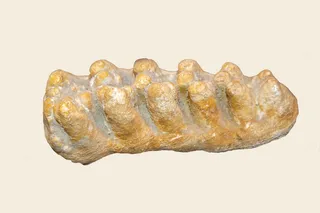


There’s no doubt that dinosaurs were formidable creatures, but something as minor as a cut or scrape could’ve had the potential to debilitate them. That’s because dinosaurs, just like us, got infections from open wounds every now and then. Sometimes, the aftermath of infections, diseases, and various injuries is seen in dinosaur bones with unusual deformations.
A new study published in Royal Society Open Science has unearthed evidence of one such case in an iguanodon that lived during the Early Cretaceous. While examining the iguanodon’s tibia, researchers found a swollen growth in the middle of the bone. CT scans of the bone revealed that the iguanodon had likely developed a skin ulcer that spread to underlying tissue, leading to the growth on the tibia.
This suggests that the iguanodon potentially suffered from a kind of bacterial infection that has never been reported in dinosaurs before.
Read More: What Caused This T. Rex’s Strange Skull Injuries?
Dinosaur Diseases and Injuries
In recent years, paleontologists have started to uncover more pathologies in dinosaurs — meaning any signs of disease, injury, or infection that have been preserved in fossils.
According to a 2020 study published in Scientific Reports, the most common pathological conditions among all non-avian dinosaur species are fractures and trauma. In some cases, fossils may also exhibit symptoms linked with metabolic diseases that deform and damage bones, like Paget’s disease or gout.

 Explore All Options
It’s much less common for dinosaurs to be diagnosed with neoplasia, the abnormal growth of tissue that forms tumors. One notable example of this came in 2020, when researchers identified an aggressive bone cancer (osteosarcoma) in a dinosaur for the first time, finding a malignant tumor in the fibula of a Centrosaurus that lived roughly 76 million years ago.
In the new study, researchers noticed an odd swelling on a tibia, or shinbone, from a carcass of Iguanodon bernissartensis that was discovered at the Mas de la Parreta quarry in eastern Spain. The next step was to find out exactly what had prompted the swelling in the Iguanodon, leading the researchers to weigh several potential causes, including trauma, neoplasia, and infection.
Investigating an Iguanodon Bone
The swelling, which measured around 6.9 inches in length and 4.6 inches in width, covered about 17 percent of the total length of the Iguanodon tibia.
To get a closer look, the researchers completed a CT scan of the tibia at a hospital, creating digital models of the bone. These models showed that the bone growth was characterized by a low thickening and moderate expansion of the cortical bone (the dense outer shell of long bones). The lesion, however, didn’t extend into the medullary cavity, the hollow central space within bone shafts where bone marrow is stored.
Based on the scans, the researchers were able to rule out several potential causes for the swelling; there was no indication that the growth was triggered by bone fracture or bone bruises; they also didn’t detect any signs of the reparative phase of bone healing seen with these types of injuries. They ruled out neoplasia as well, as there was no evidence of malignant tumors.
Living with a Painful Ulcer
With fractures and neoplasia out of the way, the researchers narrowed down the likely cause to an infection from a tropical skin ulcer, which is a painful, rapidly enlarging sore that often appears on the lower limb of an individual living in a hot, humid tropical region, according to DermNet. The Iguanodon being studied would’ve lived in Europe at a time when it had a warm, humid subtropical to warm-temperate climate, a favorable environment for tropical ulcers to proliferate.
Infection of tropical ulcers is typically polymicrobial, meaning it is caused by a variety of microorganisms. The researchers say that polymicrobial infections haven’t been observed in dinosaurs before, making this iguanodon’s case stand out.
Unfortunately for the iguanodon, the infected ulcer may have caused persistent pain, which was aggravated by normal walking and muscle pressure, according to the study. It just goes to show even dinosaurs had ailments that made life tougher for them.
Read More: Duck-Billed Dinos Broke Their Mates’ Tails, Exposing Dinosaur Sex and Sexual Difference
Article Sources
Our writers at Discovermagazine.com use peer-reviewed studies and high-quality sources for our articles, and our editors review for scientific accuracy and editorial standards. Review the sources used below for this article:
- This article references information from a study published in Royal Society Open Science: First occurrence of polymicrobial ulcer in dinosaurs
- This article references information from a study published in Scientific Reports: A comprehensive diagnostic approach combining phylogenetic disease bracketing and CT imaging reveals osteomyelitis in a Tyrannosaurus rex
- This article references information from a study published in Science: Doctors diagnose advanced cancer—in a dinosaur
- This article references information from DermNet: Tropical Ulcer