With every year, space programs are bringing us closer to a permanent presence on the moon. To make a lunar outpost livable for humans, the most important resource we need is water. With the confirmation of water ice present in the moon’s dark craters in 2013, hopes are high that it’s just a matter of time until the establishment of villages, towns, and cities on our celestial sibling.
However, will the water deposits on the moon be enough to quench our thirst for long? Researchers from the Smithsonian Astrophysical Observatory and the Space Research Center at Durham University, U.K., did the math and suggest that even with the best recycling methods and using generous estimates of the amount of water present on the moon, large human settlements could run out of water within decades.
However, their paper, published in Frontiers in Space Technologies, also states that a small moon town with fewer than 10,000 people may sustain itself with water for several centuries.
“If the lunar population is to grow beyond a hundred thousand,” wrote the authors in their study, “water management will be critical and challenging, and we should evaluate the options well in advance.”
Read More: The World Isn’t Just Running Out of Water, It’s Already Bankrupt — But There Is Still Hope

 Explore All Options
Water on the Moon Changes Everything
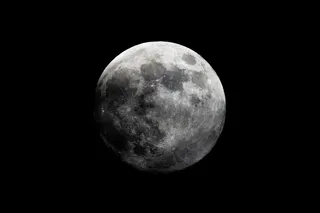
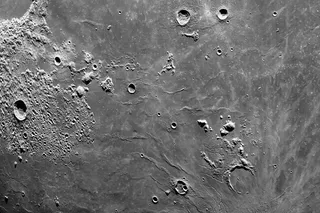
The moon we know today is covered in craters, formed by asteroids hitting its surface again and again over billions of years. These impacts may also have contributed to the water found on the lunar surface. Locked inside permanently shadowed craters near the moon’s poles, experts estimate that there could be around one billion tons of water ice based on observations from several moon-orbiting missions.
The discovery of water on the moon excited many, as long-term human visits to our closest celestial body finally seemed within reach. Water doesn’t just mean drinking it. It’s also necessary for hygiene, growing food, and producing breathable air.
Beyond establishing moon villages, people have also dreamed of establishing large industries and building cities that could sustain themselves. But how realistic are those ambitions?
Smaller Settlements Are More Feasible
Humans use a lot of water to sustain their lives. Based on current estimates from the U.S., one person requires about 125 tons of water per year for drinking and hygiene, and another 500 tons for growing food, according to the study. At those rates, a moon population of one million would use up one billion tons of water in less than three years.
Even with 98 percent efficient water recycling, similar to the highest recovery rates achieved on the International Space Station (ISS), a one-million-person city would eventually exhaust that supply.
“We show that, with reasonable consumption rate estimates, […] the roughly 1 billion tons of water potentially present in the Permanently Shadowed Regions near the lunar poles is insufficient to support a population of one million using ISS-level […] recycling for more than about one century,” explain the authors.
More realistic estimates of the amount of water on the moon are about 30 times lower than one billion tons, giving a large city even less time until they exhaust that resource. But a village of 1,000 people, or even a town of 10,000, could instead sustain its water supply for several centuries or more.
The Moon May Have Deeper Water Reserves
On the other hand, energy may not be a major limitation for future moon settlements. The rims around the permanently shadowed craters receive sunlight for most of the year, making them ideal spots for solar power.
With plenty of silicon available on the moon, settlers could potentially manufacture the solar panels there, too. The combination could even support energy-intensive facilities such as AI data centers near the sunlit peaks.
For the water problem, better recycling and more efficient ways of producing food, such as vertical farming, could help reduce demand. Water could also potentially be brought in from other sources, including asteroids. And there’s still a big unknown: Current surveys only reach a few feet below the lunar surface, so deeper reserves may yet be discovered.
“Unless recycling can be improved by factors of about 10,” add the authors, “or a similarly greater water supply is discovered, this result precludes large-scale long-term human habitation of the moon.”
Article Sources
Our writers at Discovermagazine.com use peer-reviewed studies and high-quality sources for our articles, and our editors review for scientific accuracy and editorial standards. Review the sources used below for this article:
- This article references information from a study published in Frontiers in Space Technologies: No cities on the Moon: a billion tons of water is not enough for sustainability