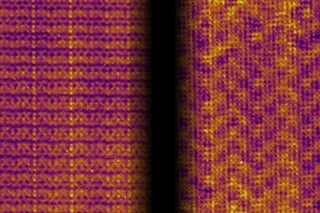


A quantum jump describes the sudden transition of a quantum system from one energy state to another.
The phenomenon had already been recorded in ions and in photons (particles of light), but until now, quantum jumps in phonons (units of sound) have remained elusive. While previous experiments have found evidence of such leaps, it had not been observed directly.
Now, in a world first, a team of physicists from Stanford University describes the observation of a real-time quantum jump. The research has been published in the journal Science.
Read More: Einstein's Equivalence Principle Passes a Quantum Test
Jumping From Theory to Observation
Quantum jumps have been theorized since the 1910s, when the physicist Niels Bohr came up with his model of the atom, according to the American Physical Society.
Breaking from conventional theory at the time, he imagined an electron traveling around the nucleus of an atom in distinct orbits. While the electron couldn’t simply glide between different orbits (or states), it could jump between them in what appears to be an instantaneous transition. The movement is less like walking up a ramp and more like stepping from one rung of the ladder to the next.
This theory has evolved over time, and the reality is far more nuanced. However, quantum jumps remain tricky to observe — they occur over exceptionally short timescales and appear to happen at random.

 Explore All Options
Indeed, the first time a quantum jump was directly observed was not until 1986, when scientists demonstrated a quantum jump in trapped ions. It was another two decades before a quantum jump was directly observed in photons (2007).
The research by physicists at Stanford now extends the ability to phonons, which, unlike photons, are not a singular particle but instead the coordinated movement of multiple atoms.
Building A Mechanical Resonator
Amir Safavi-Naeini, associate professor of applied physics in the Stanford School of Humanities and Sciences, told Discover the team first collected measurements of the jumps in the spring of 2025 — “but you had to squint to see the jumps.”
In the end, the team decided against publishing the results and instead refined the technology to reduce the noise so the result could “pop out.”
To detect a quantum jump, Safavi-Naeini and his team built a device called a mechanical resonator. The researchers describe the device as a little like a tuning fork, only on a microscopic level, that can “ring” or vibrate for periods of two milliseconds.
“A normal tuning fork sounds like it gradually gets quieter and quieter,” Safavi-Naeini explained. “The quantum version is more like an extremely tiny tuning fork where, if you could directly measure its energy, the last unit of vibration stays there for some random amount of time and then disappears all at once.”
Two milliseconds might not sound like a lot, but it is equivalent to a normal-sized vibration lasting for hours. The relatively long vibration time means the device can take hundreds of readings, and it can pinpoint the exact time that the sound jumps and changes energy state.
“Physically, the resonator goes from having one quantum of vibrational energy, one phonon, to having zero,” said Safavi-Naeini.
Measuring Signals Without Disturbing Photons
There was, however, an obstacle Safavi-Naeini and his team had to contend with, and that was how to measure those signals without disturbing the phonon.
Ultimately, Takuma Makihara and Erik Szakiel, the paper’s co-first authors, established a process that enabled them to couple the resonator with an electrical circuit known as a superconducting qubit. The latter acts as a detector, identifying the moment the number of phonons goes from one to zero.
“When they showed me the results from the new chip, it was clear that we had the result; I was extremely excited,” said Safavi-Naeini. “This is something I had wanted to see since I was a graduate student.”
Being able to detect quantum jumps of phonons could one day lead to advancements in areas such as quantum computing, quantum sensing, and even everyday technologies that involve sound, the researchers said.
In the meantime, Safavi-Naeini notes there are improvements to be made: “Our measurement is very good but not perfectly non-destructive,” said Safavi-Naeini. “We would like to reduce that disturbance, observe jumps involving higher numbers of phonons, and connect several mechanical resonators together.”
Read More: New Quantum Brain Theory Suggests Neurons May Hide Invisible Information
Article Sources
Our writers at Discovermagazine.com use peer-reviewed studies and high-quality sources for our articles, and our editors review for scientific accuracy and editorial standards. Review the sources used below for this article:
- This article references information from a study published in Science: Quantum jumps of sound
- This article references information from the American Physical Society: March 6, 13: Bohr describes his model of an atom to Rutherford