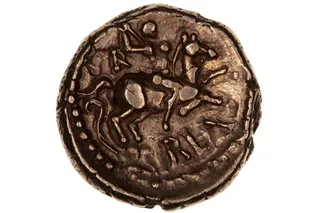


In 2019, local metal detectorist Rob Jones was scouring a field near Wrexham in northern Wales when he found a 139-pound lead ingot inscribed with the name of Marcus Trebellius Maximus, governor of Britannia during Nero’s reign (C.E. 63 to 69), according to Wrexham Council News.
It soon turned out that the lead ingot was just the tip of the iceberg — subsequent investigations have unearthed coins, ceramics and, most exciting of all, a Roman villa complex hinting at a more extensive Roman presence in the area than previously thought.
Following a recent excavation, archaeologists have announced several new findings, including the discovery of a quern stone that predates the villa.
“Finds like the quern stone allow us to look beyond the villa itself and begin exploring the much longer history of human activity in this landscape,” Caroline Pudney, a Senior Lecturer in Archaeology at the University of Chester, U.K., explained in a statement.
“Each season of excavation is revealing new layers of the story and helping us understand how communities adapted and developed in this part of Roman Britain,” said Pudney, who is the Academic Lead and co-Site Director.

 Explore All Options
Evidence of Ancient Renovations
Previous excavations at the site near Rossett, Wales, have uncovered two Roman structures, including a corridor villa, and a Medieval building made from material commandeered from the Roman remains.
This year, archaeologists announced that there are signs the main structure has changed over time, with evidence suggesting it was built in phases and that different parts of the villa were used for different purposes during its lifetime. At one point, it may even have been a bathhouse.
During the excavations, the team discovered a building with its floors still intact and relics of hypocaust heating — an ancient underground heating system found in public bathhouses and private residences.
These renovations and extensions highlight the site's dynamic nature, researchers say.
“Rather than representing a single moment in time, the archaeology is revealing a villa complex that evolved over generations, reflecting changing needs, ambitions and lifestyles,” said Pudney.
Finding A Complete Quern Stone

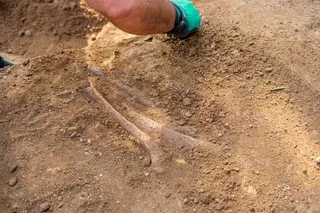
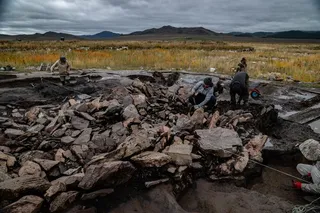
Uncovering the quern stone.
(Image Courtesy of the University of Chester)
The discovery of a complete quern stone was “a star find this year,” said Ben Swain, Project Manager and co-Site Director for DigVentures, in a statement.
Swain explained it is not just the object itself (which would have been used for processing grain) but where it was found. The quern was buried in a layer below the foundation of the villa, hinting at activity predating the villa.
A Glimpse into Roman Wales
As well as the structures themselves, researchers have recovered several artifacts, including pottery, coins, and animal bones. The presence of a hypocaust heating system and evidence of painted wall plaster suggests the inhabitants of the villa were likely wealthy and enjoyed the comforts often associated with Roman lifestyles, while imported pottery suggests they would have had access to wider Roman trade networks.
“The quality of the buildings and artifacts reinforces the growing evidence that Roman influence in this region was more extensive than previously understood,” said Pudney. “Sites like Rossett are helping to challenge traditional assumptions about the distribution of wealth and status in the western frontier zone of Roman Britain and are showing that communities here were closely connected to the wider Roman world.”
Read More: Railway Excavations Uncover a 1,740-Year-Old Coin of Britain's Breakaway Roman Emperor
Article Sources
Our writers at Discovermagazine.com use peer-reviewed studies and high-quality sources for our articles, and our editors review for scientific accuracy and editorial standards. Review the sources used below for this article:
- This article references information from the University of Chester: New discoveries at Rossett Roman villa shed light on life in Roman Wales
- This article references information from the University of Chester: Archaeological dig returns to site of Roman villa in North Wales
- This article references information from Wrexham Council News: New Discovery Sheds Light on Roman Wrexham