

Yellowstone National Park’s Biscuit Basin is back at it again with another hydrothermal explosion, though this one isn’t anywhere near as large as the notable 2024 eruption.
Since that eruption on July 23, 2024 — which shot mud, rocks, and hot water from Black Diamond Pool anywhere between 400 and 600 feet into the air while park visitors ran for cover — the area has been a hotbed of activity. Researchers from the Yellowstone Volcano Observatory (YVO) have been diligently monitoring the area ever since.
Thanks to that equipment, the YVO — part of the United States Geological Survey (USGS) — captured this small eruption on June 13, 2026. Though it wasn’t as large as previous eruptions, the impacts did cause a temporary shift in the surrounding river and opened up two new runoff channels.
Did Black Diamond Pool Erupt Again?

Milky colored water due to sediment from a hydrothermal explosion
(Photo Courtesy of Fay Yocum, Yellowstone National Park)
In the early morning on June 13, 2026, at 5:09 a.m. local time, some of the park’s monitoring equipment detected signs of anomalous activity, according to the USGS. The monitors detected signs of seismic energy and infrasound — low-frequency acoustic signals — near Black Diamond Pool.
Later on that morning, a Yellowstone National Park interpretive staff member noticed that about 3 to 4 miles of the nearby Firehole River appeared milky and full of a light grey plume. From there, researchers also noted that two new runoff channels had formed, connecting Biscuit Basin to the river.

 Explore All Options
"The river stayed like that just for a few hours. About as long as water drained vigorously from the new features at Biscuit Basin. That water scrubbed a lot of sediment from the region as it flowed from the vents to the river," Michael Poland, the scientist-in-charge at the Yellowstone Volcano Observatory, told Discover.
While this evidence raised a possibility of another explosion from Black Diamond Pool, further analysis of the data revealed that this was not the case. Park researchers examined the temperature sensor data and found only a small heat blip before temperatures returned to normal, and nothing to indicate an eruption. The team concluded that the anomalous event could not have occurred in Black Diamond Pool.
Read More: Tracking Past Eruptions In Yellowstone Is Harder Than You Think
Where Was the Latest Yellowstone Eruption?
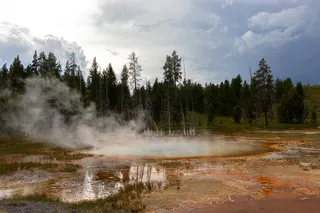
In addition to geological monitoring equipment, the USGS had installed cameras around Black Diamond Pool in hopes of capturing hydrothermal activity on video. That paid off, as the team captured footage of a dark-colored steam plume erupting just north of Black Diamond Pool, while the other monitoring equipment detected the anomalous event.
After analyzing the footage, park geologists went to the site the following day — June 14, 2026 — and found evidence of a hydrothermal surge that likely sent debris into the Firehole River from three newly formed vents. According to the USGS, these vents indicate a pathway where water that is at or even slightly above its boiling point beneath the ground suddenly finds a way to the surface and erupts into steam, thus leading to a hydrothermal explosion.
At the site, the team noted that only one vent remained active, sending water to the river. This vent was the northernmost of the Black Diamond Pool vents. There, the researchers found rocks likely ejected by the explosion, though none seemed to have been thrown very far, meaning that the explosion was likely small.
The team noted several other vents in the area that had all produced some form of water flow and sent sediment into the river.
A Surprising Find
Yellowstone Geologists returned to the site two days later — June 16, 2026 — and were shocked to find that a new thermal pool had opened up in the time that they were gone. The pool, according to the USGS, is about 21 feet by 17 feet and contains “vigorously boiling” gray, silt-like water.
"New pools like this form several times each year in Yellowstone. Usually, it is unobserved and happens in the backcountry. But every now and then, we get one in a front-country area that we can observe," Poland said.
Funny enough, the new pool had opened up right where the geology team had been walking only two days before. Since there were no rocks or debris around the pool, the team suggests it formed via collapse. Further monitoring found that on June 18, 2026, the newly formed pool showed signs of intermittent spouting, shooting hot water about 20 to 30 feet into the air.
The team will continue to monitor Biscuit Basin and the hydrothermal events that come from the area. They are currently reviewing data to identify any precursors to the formation of the new pool, so they can be better prepared in the future.
Read More: Yellowstone Cleanup Crews Tackle Litter That Causes Hot Springs to Clog and Change Colors
Article Sources
Our writers at Discovermagazine.com use peer-reviewed studies and high-quality sources for our articles, and our editors review for scientific accuracy and editorial standards. Review the sources used below for this article:
- This article references information from the USGS: Oops, it did it again: Another small hydrothermal explosion at Biscuit Basin
- This article references information from the USGS: The July 23, 2024, hydrothermal explosion at Biscuit Basin