

An animal hide can disappear long before the tools used to work it. So can the ingredients someone stirred into a pigment mixture. After tens of thousands of years, archaeologists may find the mineral material left behind while much of the activity surrounding it remains out of sight.
At a Stone Age site on South Africa’s coast, researchers writing in the Proceedings of the Royal Society B have picked up one of those missing threads — traces of an antelope preserved in an ochre-rich surface roughly 60,000 years old.
The discovery links animal material with ochre use by early humans, opening a small but intriguing window onto what people were making, handling, and treating in this location. It also shows why ancient sediment deserves a closer look, even when it contains nothing resembling a recognizable artifact.
Read More: Massive Ochre Cave Paintings are Traces of Ancient Human Migration in the Amazon
Ancient Eland Proteins Hidden in Ochre
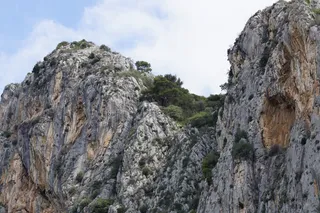
The evidence comes from the Klipdrift Complex, an archaeological site within the coastal cliffs of South Africa’s De Hoop National Reserve. Researchers investigated archived sediment samples to see whether proteins associated with ancient ochre use had survived.
Their standout find was type I collagen proteins attributed to the common eland, Taurotragus oryx, a species of antelope.

 Explore All Options
According to the team, the proteins suggest two possible explanations: People deliberately combined animal-derived ingredients with ochre, or eland hides treated with ochre were present on the surface. Either possibility connects the pigment-rich deposit with materials that are no longer visibly preserved.
Finding ochre tells archaeologists that the material was present, while identifying animal proteins alongside it gives them another clue about the activities that may have taken place.
How Scientists Identified 60,000-Year-Old Proteins
To investigate those traces, the team turned to palaeoproteomics — the study of ancient proteins recovered from archaeological or paleontological material.
First, researchers extracted proteins from the sediment. They then analyzed them using liquid chromatography-tandem mass spectrometry, a laboratory technique that separates and measures protein fragments.
The next step was identification. The researchers compared the fragments with large protein databases and a specially assembled collagen reference database, looking for matches that could reveal their animal source.
Think of it as identifying a book from surviving snippets of text. The entire original material does not need to remain intact for recognizable information to survive.
Here, that information pointed to eland. The result demonstrated that archaeological sediments can retain identifiable proteins even in African environments where ancient DNA often preserves poorly. It gives researchers another route into the biological evidence of the past when genetic material is unavailable.
What the Discovery Reveals About Early Humans
The next question is also the hardest to answer — what were people actually doing with the ochre?
The collagen cannot settle that debate on its own, as it doesn’t establish a particular recipe, prove hide treatment, or demonstrate that the activity carried symbolic meaning.
Instead, it narrows the possibilities and provides evidence for a relationship that is rarely preserved. Organic ingredients associated with ochre mixtures have been particularly difficult to document in Africa.
The early takeaways that researchers can come to right now are that early human life involved perishable materials as well as enduring stone and minerals. Recovering their molecular traces could help archaeologists investigate technical skills, everyday tasks, and potentially symbolic practices that would otherwise remain difficult to see.
At Klipdrift, a few surviving protein fragments have made that missing part of the story just a little more tangible.
Article Sources
Our writers at Discovermagazine.com use peer-reviewed studies and high-quality sources for our articles, and our editors review for scientific accuracy and editorial standards. Review the sources used below for this article:
- This article references information from a study published in Proceedings of the Royal Society B: Palaeoproteomic investigation of archaeological sediments associated with ochre use in the Middle Stone Age of southern Africa