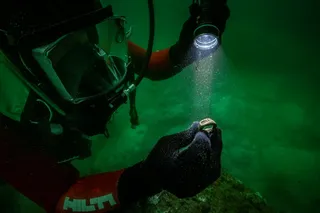
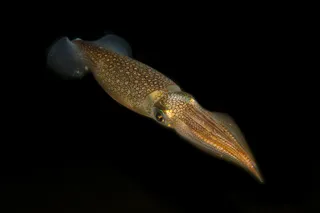
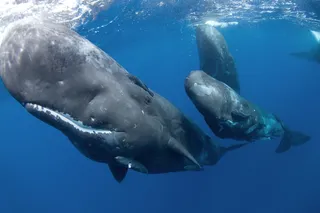
There is a seamount at the bottom of the Arctic Ocean that does not have a name. Until recently, no human had ever seen what lived on it. Last month, a research team went down to look.
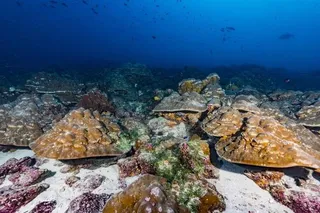
What they found, at around 9,842 feet (3,000 meters) below the surface, were sponge gardens, bamboo coral, and creatures moving through hydrothermal vents that had never been filmed before. Among them, almost certainly, animals that have never been described by science.
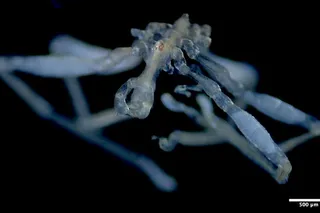
A month-long Greenpeace expedition to seamounts and hydrothermal hot springs along the Arctic Mid-Ocean Ridge concluded this week in Bergen, Norway, with researchers reporting the likely discovery of at least seven new species, including three potential sponges and four amphipods. Over 450,000 people watched the Remotely Operated Vehicle (ROV) dives live on YouTube, TikTok, and Instagram as they happened.
“These ecosystems keep on surprising us,” said Anne-Nina Lörz of the Senckenberg Society for Nature Research in a press release. “We have filmed and gathered samples from an unnamed seamount never explored by humans before. For the first time, we could see how these colorful animals live and interact.”
Arctic Deep-Sea Sponges Reveal Why These Hidden Ecosystems Matter

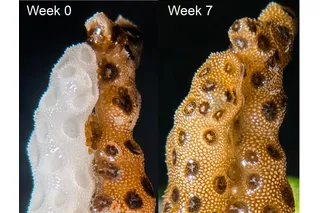
Sea sponges
(Image Courtesy of Solvin Zankl/Greenpeace)
The sponges collected during the expedition are among the oldest animal lineages on Earth, having evolved for more than 500 million years. During that time, they developed chemical compounds to repel predators and resist disease, and researchers believe some of those compounds may hold potential for treating human illness.

 Explore All Options
“The chemical compounds of the deep-sea species we find here could also hold the key to unlock cures for current and future emerging diseases,” said Paco Cárdenas, a deep-sea sponge expert from Uppsala University. “If these ecosystems disappear, we risk losing them forever.”
The sponges are just one part of what remains unknown. The ecosystems they inhabit appear to be gathering points for Arctic deep-sea life, and how many species pass through them and where they go remain a mystery.
Read More: New Species Identified On Antarctic Seafloor that was Once Covered By a Massive Ice Sheet
Deep-Sea Mining Could Destroy Arctic Life Before It Is Understood
The area surveyed was opened for deep-sea mining by the Norwegian government in 2024, a decision that prompted protests from environmental organizations, scientists, and fishing communities. Mining has been halted until at least 2029, but the area's long-term future remains uncertain.

Deep-sea starfish
(Image Courtesy of Solvin Zankl/Greenpeace)
“The deep-sea mining industry has not yet started to tear up the seabed, and we therefore have the opportunity to stop an environmental disaster before it happens,” said the chief scientist on board, Sandra Schöttner. “We will use the data and findings from the expedition to shine a light on these extraordinary ecosystems and push policymakers to establish marine protected areas.”
The concern shared by researchers is that these ecosystems, built over millennia by slow-growing organisms, could be permanently damaged before science has even cataloged what lives in them. The sponges filmed during the expedition may take centuries to reach the size they were observed at. Mining would destroy them in hours.
Arctic Samples Could Help Shape Future Ocean Protections
The samples collected during the expedition now face a longer journey through laboratories than the one that brought them to the surface. Genetic analysis will shed light on how deep-sea sponge populations are distributed and connected across the Arctic, information that will be critical for designing any future marine protected areas. Several new species will be formally described and named in the coming months, and the footage will be made available to researchers.
Norway's decision on whether to proceed with deep-sea mining after 2029 will likely be shaped in part by what this expedition and others like it find. Greenpeace is pushing for a global moratorium on deep-sea mining and for 30 percent of the world's oceans to be protected by 2030. The case for both rests partly on what was filmed last month, in a place with no name, at the bottom of a very cold sea.
Read More: Rare Arctic Seafloor Footage Captures Narwhals, Backward-Swimming Fish, and Panicked Copepods
Article Sources
Our writers at Discovermagazine.com use peer-reviewed studies and high-quality sources for our articles, and our editors review for scientific accuracy and editorial standards. Review the sources used below for this article:
- This article references information from Greenpeace International: Greenpeace ends Deep Arctic Expedition with findings of new species – and over 100 hours of video from the deep sea