In the Yorkshire village of Aldborough, an 18-foot (5.5-meter) stone cross commemorates a battle fought in 1322. In the 19th century, antiquarian J.R. Walbran proposed that whoever carved it had reused one of the Devil’s Arrows, the enormous prehistoric stones standing outside the nearby town of Boroughbridge.
Three pillars remain today, reaching almost 23 feet (seven meters) tall and forming Britain’s tallest surviving prehistoric stone row. According to local folklore, the pillars landed here after the Devil tried to hit Boroughbridge with them. People later broke up some of the fallen stones for other uses.
New research supports Walbran’s theory, linking the medieval cross to a fallen pillar from the prehistoric row. It also identifies where the builders originally obtained the blocks: Brimham Rocks, a natural rock formation at least 11 miles (18 kilometers) west of the Devil’s Arrows. The study, published in Proceedings of the Royal Society A, shows that people transported the stones from Brimham to the site near Boroughbridge despite having other stone available closer by.
“Sites in southern England and Scotland receive considerable attention, but monuments like the Devil's Arrows have remained comparatively understudied despite their significance,” said co-author Jim Leary in a press release. "We have now proved that Neolithic communities moved several 25-tonne stones 18km across Yorkshire, transforming a familiar site into an epic quest to create a sacred landscape.”

 Explore All Options
Where the Devil’s Arrows Came From
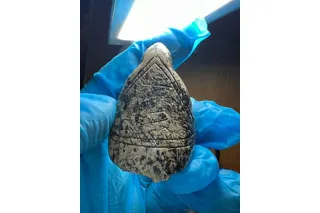
To trace the stones’ origins, lead author Anthony Clarke, a geochemist at Curtin University, and his colleagues used adhesive tape to collect tiny mineral grains from their surfaces without cutting into the pillars.
The grains included zircon and apatite. By measuring their ages and comparing the results with samples from possible source locations, the researchers matched the stones to Brimham Rocks.
Researchers had previously thought the builders obtained their stone at Plumpton Rocks, about eight miles (13 kilometers) from the Arrows. The mineral analysis instead matched the pillars to the more distant Brimham Rocks. Other gritstone outcrops lie just three miles (five kilometers) from the monument, suggesting the builders may have deliberately chosen Brimham Rocks despite the extra effort.
The researchers also checked reconstructions of how ice had moved through the region. Those showed that glaciers could not have carried the stones from Brimham to their present location, leaving people responsible for the journey.
Read More: Neolithic Farmers Were Cultivating Bread Wheat in Georgia 8,000 Years Ago
The Work of Moving and Raising the Stones
The pillars are thought to have been erected during the Late Neolithic or Early Bronze Age, possibly around 2000 B.C.E. Each weighs roughly 28 U.S. tons (25 metric tons), making their transport a substantial undertaking even before anyone raised them upright.
The Arrows also stood near a concentration of ceremonial sites. Seven late-Neolithic henges, circular earthwork enclosures, lie between the rivers Swale and Ure.
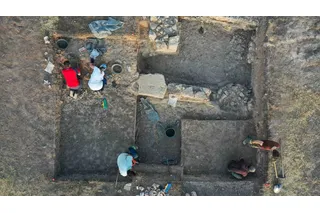
Knowing the source gives researchers somewhere to look for evidence of how the work began. Clarke’s team plans excavations at Brimham and the monument to investigate when and how people moved the stones.
“While the folklore remains a much-loved part of their story, it’s wonderful to discover that the real journey of these stones is every bit as extraordinary,” Justin Scully, the National Trust’s general manager for Fountains Abbey & Studley Royal and Brimham Rocks, said in the press release.
What Happened to the Missing Arrows
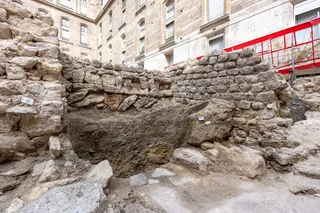
The Tudor writer John Leland recorded four standing stones in the mid-16th century. An account from 1687 describes people breaking up a fallen stone, using part in Peg Bridge over the River Tutt and taking its top to Aldborough manor.
The Battle Cross was carved in the 15th century, using what Walbran believed was another fallen Arrow.
Whoever carved the cross gave the stone a new shape and a new purpose, but left enough for researchers to recognize its connection to the Arrows. A piece of the prehistoric row had survived in Aldborough, where people had put it to use remembering a much later event in their history.
Read More: Stone Age People in Denmark Kept Fishing Even After Farming Arrived 6,000 Years Ago
Article Sources
Our writers at Discovermagazine.com use peer-reviewed studies and high-quality sources for our articles, and our editors review for scientific accuracy and editorial standards. Review the sources used below for this article:
- This article references information from a study published in Proceedings of the Royal Society A: Deliberate prehistoric sourcing of the Devil's Arrows, Britain's tallest stone row Open Access