


A girl's first period transforms her body. It is a moment that is both intimate and decisive: it marks the beginning of sexual maturity and the start of reproductive life. What no one imagined was that it could also leave a biological imprint that could last for centuries.
By analyzing the skeletons of women who lived between the 14th and 18th centuries, Spanish researchers identified a subtle mark on the femur associated with menarche, a girl's first menstrual period, according to a study in The Anatomical Record.
The discovery opens a new window into reconstructing aspects of women's reproductive history and helps illuminate a dimension that has historically received little attention in anthropology.
"Women and children have historically been overlooked," Rebeca García-González, of the Human Evolution Laboratory at the University of Burgos, told Discover.
Ancient Bone Development
A first period does not occur at a fixed age, nor was it long thought to leave an easily identifiable mark on the skeleton. Its onset depends on multiple factors, including genetics, diet, health, and living conditions. This means periods can occur at different ages, even among adolescents with similar growth trajectories.

 Explore All Options
This variability has made it difficult for researchers to identify menarche in archaeological remains. In fact, for decades, it was assumed that the event left no detectable traces in the skeleton. The researchers approached the problem from a different angle: If bone is a living tissue that responds to the body's mechanical demands throughout life, it should also react to hormonal changes.
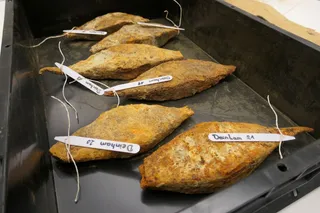
Using computed tomography, the team examined 75 femurs — 46 from juveniles and 29 from adults — from human remains recovered at the Monastery of San Pablo in Burgos. Their analyses revealed that the onset of menstruation significantly alters the way this bone develops in girls and adolescents.
The rise in estrogen levels associated with menarche triggers bone remodeling that makes the femur more compact and reduces its internal cavity size. This process is known as medullary contraction.
"Women's bones begin to grow inward," García-González explained. In males, by contrast, androgens promote outward and more pronounced growth.
"It's like a donut," she added. "Theirs is bigger, but ours has more dough.”
Through this process, women gain bone mass. This reserve acts as a kind of biological buffer: Additional bone accumulates during adolescence and later helps offset the natural bone loss associated with pregnancy, breastfeeding, and menopause.
Puberty Came Earlier for Women at the Monastery of San Pablo
Based on an analysis of the femur's internal structure, the researchers estimated that the women at the Monastery of San Pablo began menstruating at around age 15, on average. That figure is several years earlier than previous estimates for historical populations, which generally placed menarche between ages 17 and 18.
"If it occurred at 15 rather than 18, that extends the reproductive lifespan by roughly three years — the amount of time it takes to wean a child," Julia Muñoz-Guarinos, an author of the study, told Discover.
According to the researchers, this estimate is more precise because it combines tomographic analysis of the femurs with analysis of the jaws. This allowed them to calculate dental age, which is considered the most reliable approximation of an individual's chronological age at death.
Although reaching menarche at age 15 may seem late by today's standards, the researchers note that these women grew up under very different conditions.
"They had endured extremely harsh circumstances, and that delayed all aspects of growth and development," García-González explained.
The skeletons also displayed other markers of physiological stress associated with disease and episodes of childhood malnutrition.
"Their bodies weren't investing energy in reproduction. That's why menstruation arrived so late compared with modern standards — it came only once the body's basic needs had been met. These women were, in fact, the strong ones," García-González said.
This information opens the door to new questions, some of them cultural in nature. For example, did adolescents who had already begun menstruating occupy a different place within their communities? Were they treated differently or buried differently from those who had not yet reached sexual maturity?
Tracing Menopause and Other Biological Milestones
The discovery by researchers at the Human Evolution Laboratory at the University of Burgos goes far beyond estimating the age of first menstruation. Their broader goal is to determine where a woman stood in her biological development at the time of death — not only in this population, but eventually in much older human remains as well.
"We've laid the groundwork," García-González said. "Now we can distinguish between women who had already reached sexual maturity and those who had not."
After menarche, the next challenge will be identifying bone markers associated with the hormonal changes brought about by pregnancy, breastfeeding, and menopause. The team has already made progress in studying the latter and has found promising evidence, although its interpretation is more complex than that for menarche.
"From what we're seeing, the decline in estrogen levels depends heavily on a woman's reproductive history — that is, when she began menstruating, how many children she had, and how long she breastfed," Muñoz-Guarinos said.
If these markers can be validated, bones may reveal not only when a woman began menstruating, but also how she experienced some of the biological milestones that shaped her life. What began as the search for a skeletal signature of menarche may ultimately help recover aspects of women's lives that have remained invisible in the historical record for centuries.
Article Sources
Our writers at Discovermagazine.com use peer-reviewed studies and high-quality sources for our articles, and our editors review for scientific accuracy and editorial standards. Review the sources used below for this article:
- This article references information from a study published in The Anatomical Record: Tracking adolescent bone remodeling through sex-specific femoral cross-sectional changes