

The top predator of the Jurassic Period isn't what you might think. It wasn’t a giant, nor did it have very large, sharp teeth. It also wasn’t a dinosaur. Instead, it was small, more like a beaver or an otter, and hunted prey in the water about 165 million years ago.
According to a new study in the journal Nature, Megacauda sungei, a small furry mammal related to some of today’s species, was considered a top predator of mammals during its time. After uncovering fossilized remains of this ancient mammal, researchers from the Universities of Shenyang, Chicago, and Bonn noticed a unique evolutionary trait that would later become widespread among mammals.
A trait that would eventually help future mammal species thrive.
Read More: Did Prehistoric Mammals Live With Dinosaurs, and What Were They Like?
Evolution of the Soft Palate

Three images showing the fossil, the 3D Scan, and a diagram.
(Image Credit: Li et al., Nature)
From the fossil remains, the team could see that the cusps on M. sungei's teeth were curved backward, which likely helped it catch slippery prey. What surprised the researchers about its teeth is that the animal’s specialized canines had three roots instead of two.
But what was more remarkable was M. sungei's soft palate.
The soft palate is made of flexible muscle fibers and helps separate the oral cavity from the pharynx (throat). It helps to block off the nasal cavity while swallowing food and water, according to a Clinical Anatomy study. It is also helpful when it comes to suckling as a survival advantage, according to the study. This advantage may actually have helped drive mammal evolution, as mammals could use the soft palate to consume nutrient-rich milk and swallow it without getting any in their airways.

 Explore All Options
“It was this adaptation that made brain development, eventually leading to humans, possible,” Thomas Martin from the University of Bonn said in a press release. “The soft palate and the shaping of the oral cavity and pharynx are directly linked to the evolution of mammals.”
Not all animals have soft palates; some may have only a hyoid bone and different swallowing mechanisms. Crocodiles, for example, use a jerking, head-raising motion to swallow their prey, according to Martin.
“This is achieved with the aid of gravity,” Martin, who is a professor of paleontology, said in the release.
What Was Megacauda sungei Like?
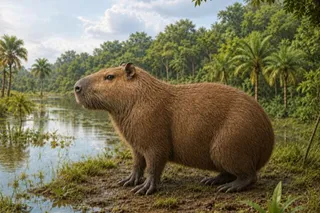
Using computed tomography, the team created a 3D reconstruction of the fossil. From it, the team determined that it may have looked similar to a beaver, otter, or platypus, with a short fur coat and flat tail, and was only about 1.6 feet long and weighed under 5 pounds.
M. sungei was also likely a good swimmer. The 3D model suggests it swam using its front legs while moving its tail in a wave-like motion, and likely steered with its back legs.
“It is the earliest evidence of an aquatic lifestyle in mammals,” Martin said.
A Giant Among Mammals
Further analysis determined that the animal is part of the extinct docodont group, early mammaliaforms that lived primarily during the Jurassic Period.
“The new species Megacauda sungei is the largest of the mammaliaforms from the Jurassic,” Martin said.
Large may sound like a stretch when we think of the mammals that live on Earth today, from the mighty elephant to the ginormous whale. Yet, for its time, M. sungei was a top predator, at least among mammals. During the age of dinosaurs, 230 million to 66 million years ago, all mammals were very small, and many weighed only a few grams. M. sungei likely appeared as a giant among them.
Previous fossil finds indicate that besides water, docodonts in the Jurassic lived underground and in trees.
“This shows how widespread docodonts were in the Northern Hemisphere and that this diverse group of animals developed very different lifestyles at an incredibly early stage,” added Martin.
Naming an Ancient Mammal
Though M. sungei is a newly identified species, researchers uncovered its fossil years earlier, according to the press release. After years of study and classification, the research team settled on the name Megacauda sungei in honor of the Honorary Director of the Paleontological Museum of Liaoning, Sun Ge, paired with Megacauda, meaning ‘large tail.’
“It is the result of a long period of teamwork,” Martin said.
Read More: 165-Million-Year-Old Insect Fossils Help Reconstruct What a Jurassic Forest May Have Sounded Like
Article Sources
Our writers at Discovermagazine.com use peer-reviewed studies and high-quality sources for our articles, and our editors review for scientific accuracy and editorial standards. Review the sources used below for this article:
- This article references information from a study published in Nature: A Jurassic mammaliaform swimmer and transformation of the mammalian pharynx
- This article references information from a study published in Clinical Anatomy: Anatomy of the Soft Palate and Its Role in Upper Airway Function: A Narrative Review