

What has red eyes, hairy legs, and is likely to give you nightmares? One of the newly discovered sea spiders from the Salish Sea.
The two species, described in the journal Organisms Diversity & Evolution, are the first to be discovered in the area in over a century and could help provide some much-needed information on this group of animals.
“I was interested in how sea spiders are impacted by climate change and human disturbance, because marine invertebrates in the Salish Sea are particularly at risk, and I couldn't find anything,” said lead author Cormac Toler-Scott, who conducted the work as part of his master’s degree in zoology at the University of British Columbia, in a press release.
“That's largely because people don't know much about what species exist here and what their lifestyle is,” Toler-Scott added.
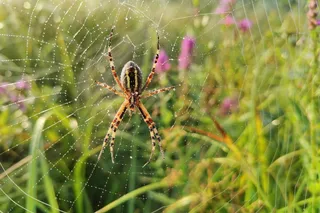
Read More: Wasp Spiders That Eat Their Mates Are Spreading North Across Britain
What We Know About Marine Arthropods

Second discovered species Tanystylum kiixin's face at 100-micrometer scale
(Image Credit: Cormac Toler-Scott)
Marine arthropods, like the two newly discovered species, can be found in oceans all around the world, but that doesn’t mean there has been extensive study on them, or that we understand them very well. We may also have difficulty identifying them.
“In order to understand how marine invertebrates are being impacted by things like climate change and how we can better protect these key elements of the ecosystem, we have to be able to identify them,” Toler-Scott said.

 Explore All Options
What we do know, according to the study, is that sea spiders began evolving around 500 million years ago. These arthropods have many land-dwelling cousins, such as spiders and scorpions. They’re even related to horseshoe crabs. One thing that separates them from their arachnid cousins, however, is that they can have more than eight legs. Some can have as many as 12. These creatures also have a sucking proboscis similar to that of a butterfly or a honeybee.
According to the study, marine arthropods in Antarctica can come in a variety of sizes, ranging from less than half an inch to almost 28 inches long, and typically eat smaller organisms. However, they can also be parasitic and latch onto larger hosts.
“They’ve retained some weird traits,” said Toler-Scott. “A lot of the shallow water species are quite small, and so they'll live as parasites on larger organisms, and they use this weird apparatus called a proboscis to suck the juices out of their host.”
Discovering the New Species

Tanystylum kiixin
(Image Credit: Cormac Toler-Scott)
Researchers collected the new species between September 2023 and August 2024 from various marine ecosystems around Vancouver, Bamfield, and Victoria, British Columbia. Divers collected some nearly 60 feet below the surface.
The first species, named Callipallene pilosuspedes, is named for the long spines that cover its lower legs, making it appear to have hairy feet. It has a short proboscis, claws for grabbing food, a triangular, three-lipped mouth, and red eyes. After examining the creature under a microscope, the team found that it also has a dexterous oviger (an appendage or leg some sea spiders have) that it can use to groom or carry eggs.
So far, researchers have only discovered one specimen of this species.
Researchers named the second species, Tanystylum kiixin, after an ancient Indigenous village near the specimen’s collection site. Unlike C. pilosuspedes, its oviger is smaller, making it harder to groom itself. Because of this, the team noted that T. kiixin was covered in other smaller parasites, which Toler-Scott called "an ecosystem within an ecosystem within an ecosystem."
What Comes Next for These Sea Spiders
Thanks to the collected specimens, the team created detailed images and ran a DNA analysis. With these specimens, the team also compiled genetic data for other sea spider species that had never been sequenced before and built out an identification guide for sea spiders in the region.
The team has registered the new species in a global database, while more species await discovery.
“I only had one field season, but there's definitely more diversity out there that we haven't documented,” Toler-Scott said.
Read More: The First Arachnids May Have Emerged From the Ocean 500 Million Years Ago
Article Sources
Our writers at Discovermagazine.com use peer-reviewed studies and high-quality sources for our articles, and our editors review for scientific accuracy and editorial standards. Review the sources used below for this article:
- This article references information from a study published in Organisms Diversity & Evolution: Sea spiders of the Salish Sea: Comparative morphology and molecular phylogenetic analysis of seven coastal species (Arthropoda, Pycnogonida)