

Yellowstone isn’t the only national park with hydrothermal features; Lassen Volcanic National Park in California also has a few hot springs, and within them is a fiery new amoeba, according to a new study from Cell.
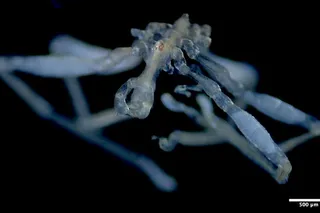
Thriving at water temperatures of 158 degrees Fahrenheit (70 degrees Celsius), this newly discovered amoeba species, Incendiamoeba cascadensis — “fire amoeba from the Cascades” — has shape-shifting abilities and can form a protective outer layer.
“This finding pushes the bounds of what we thought was possible, which is incredibly exciting,” corresponding author Angela Oliverio of Syracuse University said in a press release. “There could be more eukaryotes that can survive at even higher temperatures than we know of.”
Read More: Microbes in Yellowstone Thermal Pools Could Shed Light on Ancient Life
Analyzing Microscopic Organisms
For the study, the research team focused on eukaryotes that could survive in hot water temperatures. A eukaryote is a cell or organism with a defined nucleus, and it is classified into four groups: animals, plants, fungi, and some microbes. The upper limit for some of these organisms is typically up to 140 degrees Fahrenheit (60 degrees Celsius). Fewer still can grow in these warmer water temperatures.
In the past, researchers have noted that amoebas (single-celled eukaryotes) are among the organisms that can survive in and near warm-water features, such as hot springs. But more remained to be learned about these organisms and how they cope in these harsh environments, and they soon became the focus of this new study.

 Explore All Options
Finding the Fire Amoeba
From 2023 to 2025, the research team gathered microscopic organisms from Lassen Volcanic National Park’s hot springs and geothermal springs, where the water temperatures at the sampling sites ranged from 117 to 147 degrees Fahrenheit (47 to 64 degrees Celsius).
While the team was analyzing the samples, they noted an unknown amoeba. In the lab, researchers observed this new amoeba grow rather quickly at about 135 degrees Fahrenheit (57 degrees Celsius) — which is the highest temperature for known amoeba growth, until now.
At 145 degrees Fahrenheit, the amoeba began to undergo mitosis — where eukaryotic cells divide. From this, the team confirmed that this amoeba could both survive and thrive in these extreme temperatures, breaking previous eukaryote records.
Because of its heat-resistant abilities, the team named the new species Incendiamoeba cascadensis, which loosely translates to “fire amoeba from the Cascades.”
How the Fire Amoeba Survives in Extreme Temps
To survive these temperatures, the team found that the amoeba protects itself by shape-shifting and creating a protective outer layer once temperatures rise above 145 degrees Fahrenheit. The amoeba could even recover after exposure to water at 158 degrees Fahrenheit (70 degrees Celsius) and then return to cooler temperatures.
But how can it survive this way? After sequencing the fire amoeba’s genome, the team discovered extra genes linked to protein maintenance and DNA repair. This helped the amoeba cope with the heat better than other amoeba species. The fire amoeba’s proteins also contain more positively charged amino acids on the surface, according to the study. Researchers have observed something similar in other heat-tolerant organisms, such as bacteria and archaea (non-eukaryotes).
“Even though these organisms are so different, there’s convergence in how protein properties are selected for stability under high temperatures,” first author H. Beryl Rappaport, a doctoral student at Syracuse University, said in the press release.
With these findings, the research team hopes they can inspire future research and test organisms' tolerance without limits.
“Every time we set a new world record in sports, it’s amazing and celebrated, even if it’s by milliseconds,” Oliverio said. “We should do the same for amoebae. These very small changes expand our understanding of what we think is possible.”
Read More: Yellowstone Hot Springs Create Perfect Environment for Ancient Microbes
Article Sources
Our writers at Discovermagazine.com use peer-reviewed studies and high-quality sources for our articles, and our editors review for scientific accuracy and editorial standards. Review the sources used below for this article:
- This article references information from a study published in Cell: A geothermal amoeba sets a new upper temperature limit for eukaryotes