

Around 170 million years ago, a crocodile relative with a distinctive feature patrolled the waters of ancient Morocco for small and soft critters to eat. This croc didn’t quite fit the typical crocodilian mold, however, and that’s because its jaws were lined with rows of thin, needle-like teeth, a far cry from the teeth of most other crocodiles.
A new study published in the Journal of Vertebrate Paleontology has announced the discovery of this one-of-a-kind Jurassic crocodile relative, Ctenosuchus tenuidens. Fossils belonging to this species, found in the Atlas Mountains of southeastern Morocco, show that its teeth were comb-like and ideal for capturing small fish and crustaceans, but not so much for tearing apart larger prey.
“These feeding habits make this particular species very different to other long-snouted crocodiles, so it really is quite an exciting discovery!” said study lead author Hamzah Imran, a paleontologist at the University of Portsmouth, in a statement.
Read More: Ancient Crocodile Fossil from Egyptian Desert Rewrites One of Earth's Greatest Survival Stories
Finding Teeth From a New Species
The researchers involved with the new study found a fossil site near the Moroccan towns of Talsint and Anoual that contained two specimens of Ctenosuchus tenuidens.
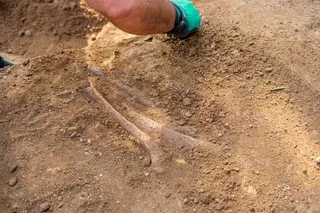
On one of the ancient crocodile fossils, they noticed little black circles on either side of a long bone. Intrigued by this, they put the fossil under a microscope to find out what these circles were.

 Explore All Options
“We carefully scratched around one of the black circles with a scalpel, and as we uncovered more of it, it became longer and longer. That’s when we realized these little black circles were actually incredibly thin teeth,” said Imran.
Smaller Snacks for Thinner Teeth
The unique shape and spacing of the fossil teeth directly inspired the new species’ name, with ‘cteno’ meaning ‘comb,’ ‘suchus’ meaning ‘crocodile,’ and ‘tenuidens’ meaning ‘thin teeth.’
By looking at the fossil teeth under a microscope, the researchers were able to find that they had specialized ridges and were closely spaced together. These traits indicate Ctenosuchus tenuidens likely had a diet consisting of smaller prey.
“The teeth are so fine that we don’t think it was catching normal prey,” said Imran. “If it caught a big fish, and the fish wriggled, those delicate teeth would get smashed. We think the animal was probably eating soft prey like shrimp, worms, and tiny fish, so nothing that would break its teeth. “
Gondwana's Rare Crocodile Relatives
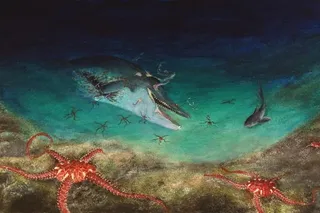
Ctenosuchus tenuidens belongs to a group of marine and freshwater reptiles called thalattosuchians, which lived from the Early Jurassic to the Early Cretaceous. These creatures have been found all across the globe, including at fossil sites in England, Germany, France, Italy, and Chile.
Thalattosuchian fossils are mostly found in areas that were once part of Laurasia, a supercontinent that formed 300 million years ago, encompassing what is now North America, Europe, and most of Asia, according to EBSCO.
The fossil record of thalattosuchians from Gondwana, another supercontinent that was located south of Laurasia, is poorly known, however. Gondwana included what is now South America, Africa, India, Australia, and Antarctica.
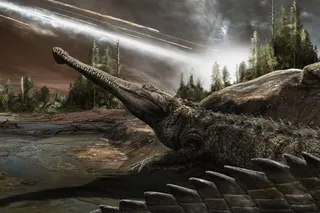
While thalattosuchians are not often found in Africa compared to other parts of the world, the species that are discovered tend to be teleosauroids; these species might have looked somewhat like gharials, modern-day crocodiles that live in rivers along the northern Indian subcontinent. Teleosauroids had streamlined bodies, short forelimbs, and powerful tails and hindlimbs.
While most teleosauroids lived in coastal or lagoonal environments during the Jurassic, some species lived in freshwater environments. The discovery of Ctenosuchus tenuidens could give researchers further insight into ancient crocodile relatives living in Gondwana during the Jurassic.
Read More: A Massive Pliocene Crocodile May Have Hunted Lucy and Other Early Hominins, 3 Million Years Ago
Article Sources
Our writers at Discovermagazine.com use peer-reviewed studies and high-quality sources for our articles, and our editors review for scientific accuracy and editorial standards. Review the sources used below for this article:
- This article references information from a study published in the Journal of Vertebrate Paleontology: A new teleosauroid (Crocodylomorpha, Thalattosuchia) with a unique dentition from the Middle Jurassic of eastern Morocco
- This article references information from EBSCO: Gondwanaland and Laurasia