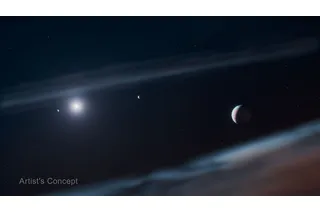


About 73 light-years from Earth lies an exoplanet that has it all backward. While planets generally orbit in the same direction as their host star, this one is an outlier: It travels around its star in the opposite direction to the star’s rotation, leaving astronomers bewildered.
A new study published in Astronomy and Astrophysics describes the peculiar case of GJ 3090 b, a Neptune-sized planet that orbits a small, cool star known as an M dwarf. GJ 3090 b is the first known planet with a “backward” orbit around an M dwarf, an anomaly that may have arisen from unusual conditions while the planetary system was forming.
“This is a remarkable planetary system because the planet is not simply tilted relative to its star — it is orbiting in the opposite direction. That immediately raises the question of how such an unusual orbit could have formed,” said study lead author Andrew Winter, an astrophysicist at Queen Mary University, in a statement.
Read More: 5 of the Strangest and Most Dangerous Exoplanets Ever Discovered
An Odd Backward Orbit
Planetary systems form when a cloud of gas and dust collapses in on itself. First, the material collapses toward the center and forms the star. The cloud spinning around the star then flattens into what’s called a protoplanetary disk, and it’s within this disk that planets are born.

 Explore All Options
A star and its planets will most often rotate in the same direction since they emerge from the same disk of gas and dust. But GJ 3090 b, with its backward orbit, seems to suggest that not all planets circling M dwarfs orbit in the same direction.
GJ 3090 b was first detected in 2022 with NASA's TESS (Transiting Exoplanet Survey Satellite) space telescope. The exoplanet was found to have a radius 2.2 times that of Earth and a mass 4.5 times that of Earth.
Finding an Exoplanet's Tilt
Recent observations of GJ 3090 b revealed the planet’s abnormal orbit; with the NIRPS (Near-Infrared Planet Searcher) instrument on the ESO La Silla 3.6m Telescope in Chile, researchers measured the three-dimensional orientation of the planet’s orbit.
The researchers were looking for an obliquity measurement in particular; NASA's Jet Propulsion Laboratory defines obliquity (or axial tilt) as the angle between a body's equatorial and orbital planes.
In the case of the eight planets in our Solar System, there is a small angle between their orbital planes and the sun’s equatorial plane. The angle varies from around 3 to 7 degrees depending on the planet, according to another statement on the new study from the Institute of Astrophysics of the Canary Islands.
The orbital obliquity gathered from measurements of GJ 3090 b, on the other hand, was approximately 136 degrees. This confirmed that the planet moves “backward” in a retrograde direction around its star.
Inheriting the Opposite Direction
With the discovery of GJ 3090 b’s retrograde orbit, researchers were left wondering why the exoplanet would be traveling in such a direction. At first, they assumed it might be the result of a dramatic gravitational interaction with either a sufficiently massive planet nearby or a companion star, which could both disturb a planet’s orbit and tilt it dramatically over time.
However, they did not find any evidence of a stellar companion or a sufficiently massive outer planet. The answer, they realized, may instead have to do with the planetary system's formation.
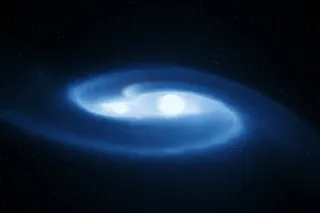
The researchers propose that the star may have acquired a second, misaligned disk of gas and dust from its surrounding environment. Planets formed from this material would've taken on an unusual orientation, as GJ 3090 b has.
“The idea that a planetary system could be rebuilt from a second, differently oriented disk is particularly exciting. It suggests that the environment around a young star can play a much bigger role in determining the architecture of its planets than we might have expected," study author Vincent Bourrier, an astronomer at the University of Geneva, said in the press release.
The researchers say that more observations are needed to verify this formation scenario and determine whether similarly odd orbital configurations may exist in other planetary systems. Regardless, GJ 3090 b's unusual orbit could shed light on the significant role of formation conditions in evolving planetary systems.
Read More: When Searching for Life on Exoplanets, a Lack of Its Signs Is Only a Starting Point
Article Sources
Our writers at Discovermagazine.com use peer-reviewed studies and high-quality sources for our articles, and our editors review for scientific accuracy and editorial standards. Review the sources used below for this article:
- This article references information from a study published in Astronomy and Astrophysics: Upside down: GJ 3090 b the first retrograde exoplanet around an M dwarf detected with NIRPS
- This article references information from NASA's Jet Propulsion Laboratory: obliquity