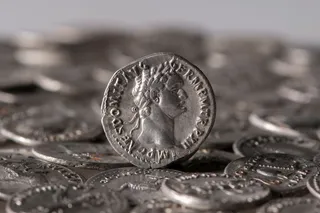


A Roman coin could spend its life traveling. Minted in one city, it might pay a soldier, cross a busy port, and eventually disappear into a buried hoard far from where its journey began. Two thousand years later, its resting place can still preserve part of that route.
One coin cannot explain the rise of Rome. Nearly four million, however, can reveal an economy taking shape. Combining archaeology, economics, and data science, researchers traced how money moved from 155 B.C.E. to 2 C.E. The results, published in Humanities and Social Sciences Communications, suggest conquest opened the door to expansion, but economic connections helped the Roman Republic thrive.
“Each coin preserved by archaeology provides three key pieces of information: where it was minted, when it was produced, and where it was found some 2,000 years later. Taken in isolation, that information reveals little. However, when millions of records are analyzed together, they can reveal the paths taken by money, the intensity of economic exchanges, the integration between different regions, and even the institutional evolution of one of the largest economies of antiquity,” said researcher Eduardo Amaral Haddad in a press release.
How Researchers Mapped Nearly 4 Million Roman Coins
Evidence from Roman coins was long dispersed among collections and archaeological records. Public databases now allow researchers to unite those finds and expose patterns invisible at a smaller scale.

 Explore All Options
After cleaning and combining the records, the team analyzed approximately four million coins in 24,646 hoards, representing 5,167 pairings of minting and discovery sites.
Using geographic information systems and spatial analysis, the team tested whether the distribution was random. It was not. Coins clustered around Roman roads, ports, cities, and trade routes, revealing likely paths of monetary circulation.
How Did the Coins Spread?
The study’s most surprising finding challenges the idea that soldiers were the main force behind the spread of Roman currency. The army mattered early, but its influence diminished after a region joined the Roman system permanently.
“What we realized was that military expansion introduced monetary circulation, but it only became established once those territories were effectively integrated, creating economic, religious, administrative, and civic structures capable of generating a permanent demand for currency,” explained Haddad.
Soldiers could introduce coins, but a monetary economy required people to keep using them. Markets, payments, religious centers, households, and cities sustained that demand.
Roman Coins Traveled Farther as the Republic Expanded
The records also captured a changing economic geography. Early coins generally remained near their point of origin. As the Republic grew, they appeared farther and farther away.
“In the early periods analyzed, coins remained relatively close to the places where they had been minted. However, as the Republic expanded its borders, they began to be found at increasingly greater distances,” said Haddad. “In statistical models, this appears as a progressive reduction in the effect of distance on coin circulation. In other words, regions previously separated by geographical barriers became progressively integrated through a common network of transportation, markets, and institutions.”
Together, the coins offer a measurable record of regions becoming economically connected and show that Rome’s durability rested not only on conquest, but on the networks built afterward.
Read More: 1,600-Year-Old Scraps Turn Out to Be a Lost Roman Law Book
Article Sources
Our writers at Discovermagazine.com use peer-reviewed studies and high-quality sources for our articles, and our editors review for scientific accuracy and editorial standards. Review the sources used below for this article:
- This article references information from a study published in Humanities and Social Sciences Communications: Economic footprints: mapping coin circulation and economic networks in ancient Rome