

After almost 22 years in space, NASA’s Neil Gehrels Swift Observatory is being retired in dramatic fashion. The roughly 3,200-pound spacecraft is expected to re-enter Earth’s atmosphere on Wednesday, Nov. 4, 2026, marking the end of an instrumental mission studying gamma-ray bursts, the universe’s most powerful explosions.
Like all satellites in low-Earth orbit, the Swift Observatory experienced slight atmospheric drag during its time in space; this means it was constantly colliding with gas molecules in the upper atmosphere, causing it to lose altitude. But without a proper propulsion system to raise its orbit, the spacecraft was bound to fall back to Earth.
Swift’s operations have concluded in preparation for its re-entry into Earth’s atmosphere, where most of the spacecraft will burn up. Although it has now run its course, Swift achieved plenty of milestones over the past 22 years, observing more than 2,000 gamma-ray bursts and taking more than 1.5 million images.
Read More: NASA’s Nancy Grace Roman Space Telescope's ‘Spy Mirror’ Could Transform How We Map the Universe
Swift's Gradual Descent
The Swift Observatory launched in 2004 to explore gamma-ray bursts, short-lived outbursts of the highest-energy light that can shine hundreds of times brighter than a typical supernova, according to NASA. The observatory also studied more than 1,400 supernovae, caught stars being shredded by black holes, and monitored active galaxies.

 Explore All Options
But Swift wasn’t designed to last in space forever, considering the mission was only meant to last 2 years before being extended.
Atmospheric drag slows down satellites in low-Earth orbit, and to remedy the resulting dip in altitude, they have to boost their orbits with propulsion systems, according to the Space Weather Prediction Center. Swift, however, doesn’t have a propulsion system to maintain its orbit.
Increased solar storms starting in late 2024 only made matters worse for Swift; the extra energy from the sun caused the low-density layers of air at low-Earth orbit altitudes to rise, and they were subsequently replaced with higher-density layers that were previously at lower altitudes, intensifying the effect of atmospheric drag on Swift.
A Last-Ditch Plan to Boost Swift
Noticing that Swift had begun sinking more rapidly after solar storms ramped up, scientists didn’t just sit idly by. In September 2025, NASA awarded a contract to Katalyst Space of Flagstaff, Arizona, to construct a spacecraft that could boost Swift’s altitude. In less than a year, the company designed, built, tested, and launched its rescue spacecraft, called LINK, in an attempt to lift Swift higher.
Soon after LINK’s launch on July 3, 2026, however, the spacecraft experienced malfunctions with its reaction wheels, which control its orientation. These problems prompted NASA to abandon the initial objective of boosting Swift; LINK was still able to rendezvous with Swift, but was not able to lift it due to its malfunctions.
Swift’s Ultraviolet/Optical and X-ray telescopes were switched off in February 2026 to minimize drag, but operations were later restarted in August after the cancellation of the Swift Boost Mission, according to NASA. In a final push to obtain data, Swift observed hundreds of science targets, from stellar explosions to active supermassive black holes.
A Lasting Legacy of Observations
Swift conducted its final observation on October 20, being shut down for good after it dropped to less than 171 miles above Earth’s surface.
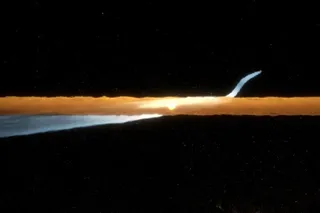
The spacecraft is now expected to re-enter Earth's atmosphere at approximately 3:30 a.m. EST on Nov. 4, 2026, with an uncertainty of 11 hours, according to NASA. Most of the spacecraft will likely burn up upon re-entry, although some components may survive and land somewhere between 20.6 degrees south latitude and 20.6 degrees north latitude; while most of this range consists of ocean, it also covers parts of South America, Africa, and South and Southeast Asia.
NASA has reassured the public that the risk of harm for anyone in those areas is very low — about 1 in 2,100.
Though the Swift Observatory will soon cease to exist, its legacy will live on through its observations both far and wide — from extreme explosions in the distant universe to comets and asteroids in our own corner of space.
Read More: Unraveling the Brightest Gamma Ray Burst of All Time
Article Sources
Our writers at Discovermagazine.com use peer-reviewed studies and high-quality sources for our articles, and our editors review for scientific accuracy and editorial standards. Review the sources used below for this article:
- This article references information from NASA: Gamma-Ray Bursts
- This article references information from the Space Weather Prediction Center: Satellite Drag
- This article references information from NASA: NASA’s Swift Mission Ends Ahead of Re-Entry