

Oliver Riedl was surveying a field near Wesseling, Germany, with a metal detector when he struck gold — or, rather, silver.
To be more specific, he discovered a silver Roman coin called a denarius. Then another. Then another. Soon, he had 15 denarii, but his probe continued to signal, suggesting there was even more to unearth.
"It was clear to me that something bigger is in the ground here," Riedl said in a statement that has been translated. "I therefore immediately notified the office."
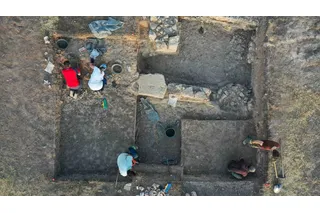
Excavations later conducted by archaeologists associated with the LVR Office for Soil Monument Conservation in the Rhineland (LVR-ABR) revealed just how significant the discovery was. Riedl had stumbled upon a hoard containing over 900 denarii, an amount more than three times what a typical Roman soldier at the time would have earned in an entire year.
The findings have now been announced in the statement released by the LVR-ABR, and the silver is being shown at the LVR-Landesmuseum Bonn in Bonn, Germany. According to officials, the hoard at Wesseling is Germany’s largest collection of coins from the Hadrian era and the fifth largest in the world.
Read More: Railway Excavations Uncover a 1,740-Year-Old Coin of Britain's Breakaway Roman Emperor

 Explore All Options
Excavating The Roman Coins

(Image Courtesy of ©Marcel Zanjani/LVR-State Service for Archaeological Heritage in the Rhineland)
Excavations began shortly after Riedl alerted officials to the discovery. It soon became clear that a large concentration of coins was buried in the field, so archaeologists extracted the findings in a block of soil, which was then taken to the restoration workshop of the LVR-Landesmuseum Bonn to be X-rayed. This enabled researchers to study the hoard before the individual coins were extricated.
During this process, the team discovered fragments of ceramic and straw, which are thought to be the remnants of a container. Rahel Otte, scientific advisor at the LVR-ABR, said it is likely the coins were buried in a pot padded with straw.
Officials credit Riedl’s actions, saying he behaved in “an exemplary manner.”
"Thanks to his prudence, we were able to recover the refuge find professionally and completely," Erich Claßen, state archaeologist and head of the LVR-ABR, said in the statement.
Discovering Germany’s Largest Hadrian-Era Hoard

(Image Courtesy of ©Marcel Zanjani/LVR-State Service for Archaeological Heritage in the Rhineland)
Archaeologists counted 934 coins, equivalent to 6.8 pounds (or 3.1 kilograms) of silver.
"This is the largest coin treasure from this time in Germany; it is the fifth largest worldwide," said Claßen.
While officials say it is hard to measure the hoard's exact value, archaeological evidence suggests a Roman legionnaire earned about 300 denarii a year. Meanwhile, a laborer would have been paid up to one denarius a day, according to the British Museum.
The majority of the coins date to the era of the Flavian emperors (69 C.E. to 96 C.E.), a period that followed the fall of Nero and the end of the Julio-Claudian dynasty. However, the oldest was minted in 148 B.C.E., during the Roman Republic, and the most recent was minted in 124 C.E. to 125 C.E., when Emperor Hadrian was on the throne (117 C.E. to 138 C.E.).
This, say researchers, suggests someone buried the hoard during the Hadrian era, though the owner may have started saving as early as 100 C.E.
Mysteries Around the Roman Silver Coins
Several questions remain unanswered, including why the hoard was buried in the first place.
“Of course, we can only speculate about the motives, but most likely someone wanted to keep this money safe. Because there were no banks at that time," said Claßen. As to why it has remained buried for so long, Claßen suggests the owner may have died before they could pass on knowledge of the coins and their location.
No one knows who buried the hoard, though archaeologists at the LVR-ABR suggest it may have been an individual living on a nearby Roman estate.
At the time, the region was an essential frontier along the Lower Rhine River, protecting the empire from Germanic tribes, with Cologne acting as the provincial capital and Bonn serving as a legionary fortress. Although the hoard has not been directly linked to any nearby sites, officials from the LVR-ABR told Discover that the now-industrial city of Wesseling was home to a legionary camp and civilian infrastructure.
Read More: Nearly 4 Million Coins Show How Rome Built an Economy Across Its Conquered Territories
Article Sources
Our writers at Discovermagazine.com use peer-reviewed studies and high-quality sources for our articles, and our editors review for scientific accuracy and editorial standards. Review the sources used below for this article:
- This article references information from the British Museum: Coin Values
- This article references information from the LVR Office for Soil Monument Conservation in the Rhineland (LVR-ABR)