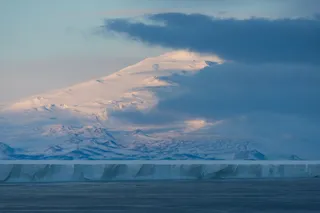
An extremely shallow pond exists in Antarctica, in one of the driest places on Earth. As temperatures drop below zero degrees Fahrenheit, the pond remains liquid all year-round.
Don Juan Pond is comparable to extraterrestrial environments like Mars and is also the saltiest body of water on the planet, thought to be simply too extreme to support life. Around the turn of the century, scientists pointed to similar locations as environments too hostile for microbes to survive.
But it turns out this unusual pond is actually teeming with bacteria.
Scientists involved in the Extreme Microbiome Project (XMP), a research effort initiated in 2014 involving microbiologists, geneticists, oceanographers, and bioinformatics, have spent years traveling to some of the harshest environments on Earth searching for life in places long assumed to be sterile, including Don Juan Pond.
To collect samples from sulfur caves, or the edges of volcanoes, researchers often require respirators, protective suits, and climbing gear to reach remote and hostile terrain, all to map how far life can go.

(Image Courtesy of Scott Tighe)
“We've never been to a spot that has not had bacteria or fungi,” Scott Tighe, renowned microbiologist, expert in genomic sciences, and lead of the XMP, told Discover. “The world has very little sterile areas in it.”

 Explore All Options
Microbial life appears almost everywhere scientists look, like remote caves and ocean depths, and within our own human gut. Yet much of it remains fundamentally unknown.
Researchers call this vast unknown “microbial dark matter,” borrowing the term from physics, where dark matter describes invisible material that cannot be directly observed but whose effects can still be detected. In microbiology, the phrase refers to organisms, including bacteria, fungi, archaea, and viruses, that scientists expect to exist but cannot yet fully classify, grow, or understand.
Katrine Whiteson, professor in the Department of Molecular Biology and Biochemistry at the University of California, Irvine, and co-director of the UCI Microbiome Center, defines microbial dark matter as the enormous portion of microbial life whose genetic material does not match anything in existing databases.
As technology advances, so does our knowledge, but still, the sheer vastness of unexplored microbial potential sometimes appears daunting. Every day, dedicated scientists around the globe are working to illuminate this unknown world, not only to understand how life survives in Earth’s harshest environments, but also because microbial dark matter has direct relevance to human life.
“It is quite interesting […] to dig a hole that is 2 feet deep and find microbial life that lives in a biofilm that's 50,000 years old,” Tighe told Discover. "Just flying to these places in a helicopter and seeing the sights is mind-boggling. And then seeing what is living, that's never been seen before.”
Why a Vast Amount of Microbial Life Remains Unknown
While the phrase “microbial dark matter” has gained visibility in recent years, the scientific challenge behind it has existed for decades. Whiteson started her investigation of the human microbiome in health and disease almost 20 years ago at a time when the word microbiome was rarely used in the scientific literature.
When scientists say most microbes are “unknown,” they do not necessarily mean hidden organisms waiting to be discovered in remote corners of Earth. Instead, they mean that much of the genetic material they recover doesn’t yet have a name, a function, or a place in existing databases.
In that sense, microbial dark matter doesn’t lend itself to neat percentages (like the frequently circulating statement of us only knowing 1 percent of all microbes on Earth), but it reflects the gap between what scientists can currently observe with the tools and technologies they have and the much larger universe of microbial life that exists beyond our reach.
One important frontier of microbial dark matter research is extremophiles, organisms that adapted to environments once thought incapable of supporting life. Beyond the salty and freezing Don Juan Pond in Antarctica, acidic lakes, deep ocean floors, and volcanic systems have been found to harbor microorganisms despite toxic chemicals present, crushing pressure, and intense temperatures.

Ethiopian Hot Springs.
(Image Courtesy of Felipe Gómez)
But even by simply tapping wastewater, or sampling the microbiomes in and on our bodies, undescribed microbes lurk everywhere. Some are harder to collect than others, and further analysis strictly depends on the exact research question scientists are trying to answer.
To understand how, for example, bacteria interact with each other, what compounds (secondary metabolites) they can produce under certain conditions, simply put, their behavior or phenotype — growing them on a Petri dish is a common tactic. But this is already where things can become tricky.
“Since the 1970s, we've described that discrepancy between what you see in an environmental or a human sample and what you can grow,” Whiteson told Discover.
Researchers may observe abundant microbial life under a microscope immediately after collecting a sample, only to fail when attempting to recreate the conditions needed to keep those organisms alive in the laboratory.
“We've described that as the great plate anomaly,” she added.
For extremophiles, recreating those conditions can become extraordinarily difficult. For instance, barophiles, microbes that thrive in tens of thousands of feet below in the depth of the ocean, need to be grown at around 10,000 pounds per square inch (which equals the pressure of a jetliner on a shoe) and even if you have the lab set up to provide this condition, “you’re probably only getting a small fraction to grow,” said Tighe.
Although scientists are becoming better at growing microbes on plates, which is especially relevant when collecting and studying all the small molecules they produce under certain conditions (a method called metabolomics), according to a study published in Critical Reviews in Microbiology, experts have increasingly turned to extracting microbes’ blueprint, DNA, directly from their samples instead of relying solely on growing microbes in petri dishes.
Collecting and analyzing microbial DNA is important because it can provide a more complete picture of microbial communities and help describe new species. But obtaining DNA, nestled inside the cell, can become a challenge. Some microbes possess extraordinarily resilient cell walls shaped by lifetimes in extreme environments and are surprisingly hard to crack with conventional lab methods.

(Image Courtesy of Scott Tighe)
“I've had microbes that I've worked with for months,” Tighe told Discover. “I can't get DNA. I can't get them open.”
Whiteson encounters similar issues when studying the human microbiome. “Each microbial cell type has different types of cell walls, and they're hard to crack,” she said.
Improving how scientists collect clean, contamination‑free samples and crack open microbes’ often formidable cell walls to access their genetic material remains an ongoing challenge across microbiology, as described in an article published in National Science Review in 2020. Until those tools improve, much of microbial life will remain unseen.
The Influence of Microbial Dark Matter on Human Life
The effort to better understand microbial dark matter extends far beyond scientific curiosity. The microbes scientists already know best tend to be the ones easiest to grow, detect, or link to illness. But mounting evidence suggests that many of the organisms that may be closely tied to long‑term health, as laid out in a 2025 Nature study, environmental stability, and even future medicines remain poorly understood or unnamed.
Take the human microbiome, consisting of vast communities of bacteria, fungi, and viruses living in and on the body. Whiteson emphasizes how, through human history, our bodies have been colonized by a pretty consistent set of microbes that we inherited from our ancestors, with evidence tracing them all the way back to our African roots. These microbiomes have been passed down over generations and human migrations over thousands of years.
However, since the Industrial Revolution, humans’ lifestyles have drastically changed in a short period of time, threatening the composition and performance of microbial cultures that supported us since time immemorial.
But how do we understand what the actual changes are, since we’re still grasping the microbial dark matter within us today? One way is to look at the people in isolated communities that have lived the same way for thousands of years, mostly unaffected by industrialized and processed foods, and see how they compare to us.
“One of my favorite experiences since I've had my lab in the last 12 years,” Whiteson told Discover, “was collaborating with an anthropologist and [taking] samples from people in the Amazon in Ecuador.”
After sequencing oral and fecal microbiomes from the Conambo people, Whiteson and her team identified large amounts of previously undescribed microbial material, suggesting that these are part of the ancient microbes that accompany us throughout human history. “And we’re losing them now,” Whiteson added.
The findings contribute to broader discussions around creating microbiome vaults, biobanks intended to preserve microbes of human history.
“These microbes that have been promoting human health through the ages,” she told Discover.
The Impact on Medicine
Microbial dark matter may also hold enormous pharmaceutical potential, according to a 2024 review published in Advanced Biotechnology. One area where bacteria and other microbes have a leg up on us is their ability to produce secondary metabolites, which are chemical by-products used for defense and survival that humans have already harnessed for medicine.
Penicillin remains the most famous example, originating from fungi that naturally produce antibiotics to compete against bacteria. Many other antibiotics used today are themselves derived from bacteria, as they make their own chemicals to protect themselves from other harmful strains.
Besides antibiotics, immunosuppressants, like Rapamycin, or a wide array of chemotherapy agents to tackle cancer are derived from our microscopic allies. Since there are still many underexplored areas on our planet, like the vast deep sea, scientists view them as treasure troves for drug discovery.
“We need more compounds to save lives,” said Tighe. “And it's so hard to get new ones now.”
He hopes future research into extremophiles may contribute to the discovery of new drugs over the coming decades.
Read More: Fat Molecules in Deep-Sea Mud Volcanoes Reveal How Microbes Survive Extreme Conditions
Mapping the Unknown
Recovering microbes from odd places and isolating their DNA is only the beginning. Finally cracking microbes’ walls and releasing their DNA creates enormous datasets that researchers must then analyze and interpret.
When Whiteson worked on her first oral metagenome, the genetic material derived from multiple organisms present in a sample in 2008, many of the computational tools available today did not yet exist.
The fast-evolving field of artificial intelligence and machine learning is increasingly being integrated into microbiome research to help scientists process large amounts of genomic data.
“I think that using AI will make it easier for people to train and use the tools in our field,” said Whiteson to Discover. “I've been using machine learning to analyze the data for more than 10 years.” Still, she cautions against overstating its current abilities. “AI is really helping with that, but I would not say it has yet changed what we can do with the data.”
Even with powerful analytical tools, researchers must decide which parts of the data to focus on and which to leave behind. Whiteson pointed out that many studies only analyze DNA sequences that already match existing databases, while vast amounts of unidentified genetic material are excluded from interpretation.
It’s why she teaches students to always ask one question: what fraction of the data was ignored? The problem reflects why microbial dark matter can persist even after sequencing, highlighting the growing gap between what modern technology can detect and what scientists can actually interpret.
Ancient Microbes and Modern Health
That interpretive gap becomes especially fraught when previously ignored genetic material appears to carry traits humans already fear. As researchers become better at recovering genetic material from extreme environments, microbial dark matter research is also raising questions about forgotten genetic traits re-entering modern ecosystems. For instance, after being locked in remote ice for millennia, some bacteria are slowly released into the environment due to a warming climate.
Recent studies, such as a Frontiers of Microbiology paper from February 2026, analyzing ancient microbial DNA preserved in ice depots, have identified antimicrobial resistance genes, prompting concern over how environmental change and thawing ecosystems may interact with modern health challenges. This shows what dangers lurk in the exploration of microbial dark matter, and fuels concerns that the exploration of microbial dark matter could open a Pandora’s box.
However, Tighe emphasizes that finding genes does not equal finding danger. He is deeply concerned about public fear-based interpretations of microbial genomics, especially around antimicrobial resistance.
The presence of resistance genes in environmental microbes is actually expected and evolutionarily normal, he explained. Without phenotypic evidence (how microbes behave instead of simply looking at genetic potential), claims alone are misleading and often exaggerated.
He added, “genomic DNA itself does not tell you the function.”
The Essence of Discovery Starts with Pure Curiosity
The advances in microbiology prove that Earth has very few truly lifeless zones, holding treasures and mysteries yet for us to explore.
Despite developing technologies, science is still at an early stage, with questions about microbial life that haven’t even been asked yet. And sometimes a precise question does not necessarily need to precede scientific research.
Whiteson shared that she quite enjoys purely discovery-based projects, as sometimes a hypothesis can be limiting when you just want to explore what microbes are in a specific sample and compare it to going “on a fishing expedition.”
She adds, “I think a lot of people think about science as a list of facts that's already sitting in a textbook, as if it's all been discovered. But we've barely scratched the surface. In most cases, and in most fields, what we know is a lot less than what we don't know.”
This article has been updated by the Discover staff to correct a minor edit on June 8, 2026.
Read More: Close, Social Contact Can Shape a Gut Microbiome, Sometimes Making it More Alike
Article Sources
Our writers at Discovermagazine.com use peer-reviewed studies and high-quality sources for our articles, and our editors review for scientific accuracy and editorial standards. Review the sources used below for this article:
- This article references information from a study published in the National Library of Medicine: Microbial dark matter coming to light: challenges and opportunities
- This article references information from Critical Reviews in Microbiology: Peeling off the layers from microbial dark matter (MDM): recent advances, future challenges, and opportunities
- This article references information from a study published in Advanced Biotechnology: Mining microbial and metabolic dark matter in extreme environments: a roadmap for harnessing the power of multi-omics data
- This article references information from a study published in Frontiers in Microbiology: First genome sequence and functional profiling of Psychrobacter SC65A.3 preserved in 5,000-year-old cave ice: insights into ancient resistome, antimicrobial potential, and enzymatic activities