There are places on Earth where massive magma reservoirs sit just a few kilometers below the surface, usually revealed by eruptions, gas emissions, or shifting ground. That wasn’t the case in Tuscany, where researchers have now uncovered a huge reservoir buried underground.
Researchers found between 5,000 and 6,000 cubic kilometers of molten and partially molten rock buried 4.97 to 9.32 miles (8 to 15 kilometers) below the surface beneath southern Tuscany, particularly near geothermal regions like Larderello and Mount Amiata, a volume comparable to the magmatic systems beneath supervolcanoes like Yellowstone.
In a study published in Communications Earth & Environment, researchers used ambient noise tomography to detect the reservoir, using natural ground vibrations to map structures within the Earth’s crust.
The finding helps explain the region’s unusually high geothermal activity and points to a new way of identifying hidden magma systems, along with the energy and mineral resources often associated with them.
“We knew that this region, which extends from north to south across Tuscany, is geothermally active, but we did not realize it contained such a large volume of magma, comparable to that of supervolcanic systems,” explained lead author Matteo Lupi in a press release.
Finding a Hidden Magma Reservoir Beneath Tuscany
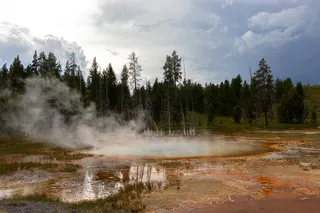
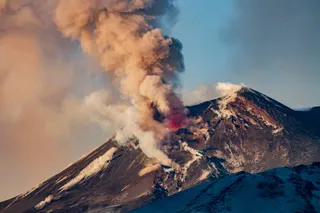
Large magma systems are usually identified through visible signs at the surface. Places like Yellowstone, Lake Toba, and Lake Taupō show clear evidence, including craters, eruptive deposits, and gas emissions.

 Explore All Options
Tuscany looks different. The region has seen little volcanic activity in recent history, and no major eruptions have been recorded in modern times. That has made it difficult to confirm what lies underground.
There were clues, just not obvious ones. The area is known for intense geothermal activity, including unusually high heat flow and active hydrothermal systems. Temperatures can exceed 932 degrees Fahrenheit (500 degrees Celsius) at relatively shallow depths.
The new imaging brings those pieces together, showing that a large volume of magma and partially melted rock is stored deep within the crust.
Read More: What Happens When Magma and Earthquakes Align in Yellowstone National Park?
Using Natural Vibrations to Map the Deep Earth
To uncover the system, researchers used ambient noise tomography, a technique that analyzes natural ground vibrations generated by ocean waves, wind, and human activity.
As these vibrations travel through the Earth, they slow down when passing through molten material. Scientists can use those changes to map where magma is likely present.
Using data from more than 60 seismic sensors (instruments that record ground vibrations), the team built a three-dimensional image of the crust beneath Tuscany. The result revealed a magmatic system comparable in size to those beneath well-known supervolcanoes.
The data also showed large zones where seismic waves move unusually slowly, a pattern commonly linked to magma or partially melted rock. In some areas, the melt fraction may be especially high. Surrounding regions likely contain a mix of molten and solid material that can still feed geothermal systems.
Why It Matters for Energy and Earth Science
Deep magmatic systems like this are closely tied to geothermal energy. They are also linked to the formation of lithium and rare-earth elements used in technologies such as electric vehicle batteries.
By offering a faster and more cost-effective way to explore the subsurface, ambient noise tomography could help identify these resources in other regions.
"These results are important both for fundamental research and for practical applications,” Lupi said.
Despite its size, the reservoir does not currently pose a volcanic threat. Instead, it shows how large magmatic systems can exist deep underground without producing obvious surface signals.
Read More: A Mysterious Ground Shift Returns to Yellowstone, and Advanced Tech Is Helping to Monitor It
Article Sources
Our writers at Discovermagazine.com use peer-reviewed studies and high-quality sources for our articles, and our editors review for scientific accuracy and editorial standards. Review the sources used below for this article:
- This article references information from a study published in Communications Earth & Environment: High-enthalpy Larderello geothermal system, Italy, powered by thousands of cubic kilometres of mid-crustal magma