

Since the European Space Agency’s (ESA) Mars Express satellite reached the Red Planet in 2003, it has helped us uncover some of Mars’s secrets. In 2018, it spotted something odd: a massive cloud of water ice near the Arsia Mons volcano.
After tracking it for a while, Mars Express determined that the cloud appears during spring and summer in Mars’ Southern Hemisphere, and each day during that time it appears, grows larger, and then fades away, usually stretching up to about 1,118 miles (1,800 km). From what researchers could tell, this odd formation is known as an orographic cloud, similar to the clouds on Earth that form when wind flows past volcanoes, mountains, and other craggy terrain.
Try as they might to understand how this cloud, the Arsia Mons Elongated Cloud (AMEC), formed, researchers have been stumped. Simulation after simulation has failed to produce this cloud formation, until now, that is.
“To create the AMEC in our [modeling], we found that we needed to include some exotic physics… physics that, while included in textbooks, is treated as theoretical and usually thought not to happen in nature. It certainly hasn’t been seen in action before,” Jorge Hernández-Bernal, lead author of the new study, said in a press release. “Once we included this physics in our simulations, the AMEC emerged just as we hoped.”

 Explore All Options
Hernández-Bernal, who is part of the Laboratoire de Météorologie Dynamique (LMD) founded by the French National Centre for Scientific Research (CNRS) and Sorbonne Université, and colleagues published the findings in Nature Geoscience.
A Martian Cloud Forming Without “Stuff”

Arsia Mons Elongated Cloud
(Image Credit: ESA/DLR/FU Berlin (acknowledgment: J. Cowart/ CC BY-SA)
While analyzing AMEC data, the research team noted that the cloud didn’t seem to form the way clouds on Earth typically do.
On our planet, clouds tend to form as moist air cools and water vapor condenses into droplets or ice crystals, according to the press release. This process, known as heterogeneous nucleation, also requires other particles, like dust, pollen, salt, etc., for the vapor to condense onto and cling to.
For most clouds on Mars, the research team believes the vapor may be clinging to dust. But the study finds that the AMEC may not need dust to form.
“For the AMEC, it seems that cloud formation takes place without needing any of this ‘stuff,'” Hernández-Bernal said. “Water [vapor] turns directly into icy cloud particles without any middle step. It’s akin to droplets of condensation appearing in the middle of a room, rather than on a window. We call this homogeneous nucleation, and we’ve never seen it before in a planetary atmosphere. It’s wholly unexpected.”
How This Odd Martian Cloud Formed
Some researchers suggest this process could occur in Earth’s upper atmosphere, and possibly on Venus as well, though there’s no evidence it has happened, likely because of the exceptional circumstances required. Humidity levels would need to be over 100,000 times higher than they typically are on Earth, according to the study.
“We’ve not seen these conditions on Mars before, but our finding now strongly suggests that the planet’s humidity can indeed reach these extreme levels,” Hernández-Bernal said.
The researchers found that the AMEC lies in a sweet spot where Arsia Mons volcano, which stands about 12 miles tall, and Mars’ thin atmosphere come together to possibly create the perfect conditions for this cloud to form.
The formation likely occurs as winds flow past Arsia Mons, triggering a powerful wave that then lifts moist air into the atmosphere in only a few minutes. The moist air then cools rapidly, dropping the temperature by about 30 degrees in about 10 minutes. The study also says this spikes relative humidity levels. From there, the water vapor freezes into cloud particles, and the AMEC forms.
While the model isn’t exactly perfect, “the result is remarkable,” Hernández-Bernal said. “We don’t have nearly as much information about Mars’s atmosphere as we do about Earth's, so reproducing the AMEC to this degree is a big success for the model.”
Relying on the Mars Express
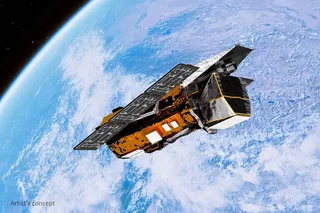
These models wouldn't have been possible without data collected by Mars Express. Thanks to three of its cameras — the Visual Monitoring Camera, High Resolution Stereo Camera, and OMEGA — Mars Express can observe Mars during the morning hours, when the AMEC appears.
“Mars Express can also track how the cloud is changing on timescales of mere hours, which gives us an [unrivaled] view of short-lived phenomena on the planet,” said ESA Mars Express Project Scientist Colin Wilson in the press release. “Overall, this finding is a true accomplishment for the mission and its scientists: Mars Express discovered the AMEC, has followed up and monitored it for years, and is now helping reveal the secrets of its formation.”
Read More: Martian Soil Mixed with Gelatin and Yeast May Help 3D-Printed Houses Break Ground on Mars
Article Sources
Our writers at Discovermagazine.com use peer-reviewed studies and high-quality sources for our articles, and our editors review for scientific accuracy and editorial standards. Review the sources used below for this article:
- This article references information from a study published in Nature Geoscience: Homogeneous ice nucleation from water vapour suggested by elongated clouds on Mars
- This article references information from the ESA: Mars Express