

Earth’s formative years — a few billion years ago — saw the rise of the atmosphere, the filling of the oceans, and the beginnings of life. However, due to natural events such as subduction, burial, and erosion, much of the geological evidence from that time has been lost. Many holes were left to fill when it comes to understanding the formation of Earth and the life that came after that.
By using moon samples and ancient meteorites, researchers writing in the journal Geology may have uncovered new evidence of a large asteroid impact that may have shaped Earth and everything that followed.
“On Earth, the first fossil evidence of life shows up around 3.5 billion years ago, meaning that life is emerging and evolving before then. The question that we often have, even going back further, is what was the impact record when life was emerging?” Carolyn Crow, a planetary scientist at the University of Colorado Boulder, said in a press release. “It is important for understanding how life is taking hold, how life is emerging. The cadence of these catastrophic events is an important part of the equation.”
Read More: Earth and the Mysterious Planet Theia Were Likely Close Neighbors Before the Moon Formed

 Explore All Options
Evidence of a 3.5-Billion-Year-Old Impact
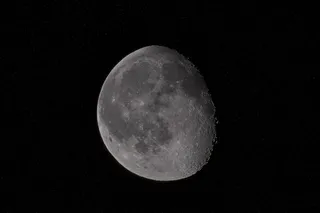
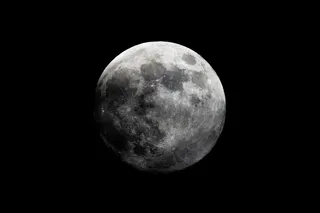
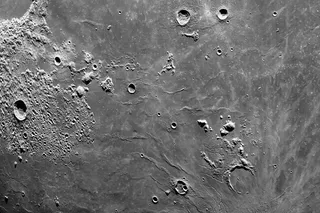
To better understand Earth’s early evolution, researchers often examine geological samples that likely originated on the moon. Earth and the moon share a common impact history, but because there is no active geological activity on the moon, its samples often contain much more valuable information.
For this study, the research team discovered that there was likely a large impact event on the moon about 3.5 billion years ago, which matches other known impacts on Earth and asteroids in the asteroid belt around our planet, from the same time. By analyzing a lunar meteorite from northwest Africa — called NWA 12593 — the team found evidence of three separate impact events.
The first event occurred about 3.5 billion years ago, according to radiometric dating, and was likely massive. The impact may have been large enough to cause the surface of the moon to turn molten, resembling a lava flow. The heat from this impact likely transformed zircon into cubic zirconia. Although the mineral usually doesn’t retain its form when the cooling process isn’t controlled, the team found traces of the mineral in the samples studied.
A Rare Celestial Line-Up
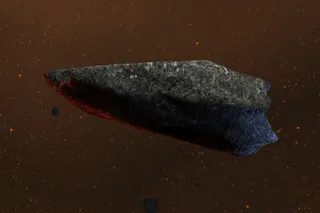
For the second impact event, the team needed to look no further than the meteorite sample itself. The meteorite is composed of a rock called breccia and likely formed after a smaller impact broke the molten lunar sheet apart.
“Breccias are similar to what you would see if you went and chipped out a chunk of concrete. You would see all these little rocks, and then it's fused together by the cement,” Crow said. “But the meteorite is fused together by the impact process. You get all these chunks of different kinds of rocks that the impact hit into. These all get mixed up, and then it gets fused together like your concrete sidewalk.”
For the third impact, the evidence comes from the fact that the meteorite is on Earth, according to the study. That impact likely struck the moon, sending breccia fragments to our planet.
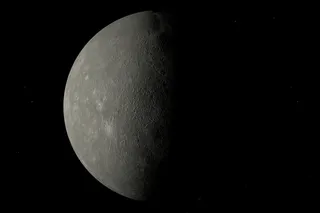
From NWA 12593, the team aligned the first impact with other known impacts on Earth and asteroid 4 Vesta, the fourth-largest asteroid in the surrounding asteroid belt. It’s rare, according to the study, to find simultaneous impact events on three celestial bodies. The evidence from the meteorites helps reveal key information about a transitional time in our Solar System.
“It's not very common, which is why we're very excited about it,” Crow said. “It's pretty rare to have all three records line up like this.”
Read More: Saturn's 128 New Moons May Be Remnants of Past Cosmic Collisions
Article Sources
Our writers at Discovermagazine.com use peer-reviewed studies and high-quality sources for our articles, and our editors review for scientific accuracy and editorial standards. Review the sources used below for this article:
- This article references information from a study published in Geology: Three-body evidence of ca. 3.7 Ga to 3.2 Ga bombardment across the inner solar system